IOGP Europe’s response to the call for evidence on the General Block Exemption Regulation (GBER)
IOGP Europe welcomes the opportunity to provide feedback to the call for evidence on the General Block Exemption Regulation (GBER), in the context of its general revision. Overall, we consider that GBER’s objectives and provisions are a good step towards the Union’s targets of promoting growth, simplify State aid rules and prioritization of enforcement on aid with the highest impact on EU Single Market.
The Regulation is also aligned with core EU policy objectives, such as the green transition, the development of R&D, the uptake of private investment and the strengthening of the EU’s competitiveness.
However, this alignment could be enhanced by keeping the GBER up to date with recent policy developments, such as the publication of the Clean Industrial Deal (CID) and the related State Aid Framework (CISAF). Moreover, its effectiveness could be strengthened, and its scope could be expanded to better tackle the competitiveness challenges the EU currently faces in its path towards the Net-Zero target.
IOGP Europe is committed to working in partnership with EU institutions and stakeholders to improve the GBER’s impact and operation, ensuring it makes a meaningful contribution to Europe’s security and climate objectives.
The objectives of the GBER revision
The current GBER does not adequately support the EU’s climate-neutral transition in a comprehensive way. Its scope is
overly restrictive, lacking true technology neutrality and failing to fully recognize the role of low-carbon solutions, together
with that of renewables.
The framework provides only limited funding opportunities for energy and decarbonisation projects. This disproportion becomes clear when compared to the multi-billion costs of renewable energy, hydrogen (both renewable and low-carbon), CCUS, and other innovative low-carbon technology projects. As a result, the effectiveness of the GBER is significantly constrained. This could be enhanced with a tailored revision: an expansion of GBER’s scope and higher aid intensities for
longer periods.
Finally, competitive bidding is – by nature – an efficient and transparent way to ensure proportionality of granted aid and to keep support amounts to the minimum, especially for large projects. Hence, the fulfilment of its conditions should not require additional assessments, funding gap analysis or claw-back mechanisms. This would remove the unnecessary overlaps the current GBER presents, avoiding duplication of assessments, cutting the red tape, providing greater predictability and enhancing effective support for aid beneficiaries.
Recommendations on the objectives of GBER revision.
• Technology neutrality: expand its scope to all relevant decarbonisation technologies, introducing higher aid
intensities for longer periods (up to 15 years for large-scale projects) to effectively de-risk investments in the field.
• Competitive auctions: introduce well-designed competitive bidding mechanisms, coupled with simplification, as
they could lead to optimal fund allocation while reducing administrative burden.
Scope of the GBER (Chapter II)
The scope of the GBER remains too narrow to support the EU’s strategic transition priorities, namely the decarbonisation of industrial sectors while enhancing competitiveness. Several categories of projects central to decarbonisation that meet the block exemption criteria are not currently included in the GBER, or only indirectly addressed (e.g. Net-Zero strategic projects; integrated transition projects combining energy, decarbonisation and training measures). This forces projects into lengthy Climate, Energy and Environmental Aid Guidelines (CEEAG) notifications from Member States, delaying deployment. In parallel, key definitions listed in Article 2 of the GBER (e.g. “renewable energy”) result outdated and not aligned with EU taxonomy (which includes e.g. CCUS), or industrial policy.
Moreover, Article 2(50) of the current GBER defines “initial investment in favour of new economic activity” based on NACE four-digit classifications. This reliance on NACE codes risks excluding genuinely innovative or transformative industrial activities simply because they remain within the same classification, regardless of the underlying R&D, new supply chains or strategic contribution to the EU’s decarbonisation goals. For example, a manufacturer of electric motors for the oil and gas sector (NACE 27.11) wishing to reorient its production towards advanced condensers for grid stability would still fall under the same code and thus not qualify as a “new economic activity.” Such rigidity obstructs the regulation’s intended purpose of supporting diversification and industrial transformation.
Furthermore, the obligation for ex-post evaluation of large aid schemes is also disproportionate: current thresholds capture too many energy and industrial projects, adding bureaucracy without meaningful benefits. A more proportionate
approach would raise thresholds, limit evaluation to long-term or innovative schemes, and treat it as a reporting requirement rather than a (pass/fail) block-exemption condition.
Regarding compatibility conditions, the current “incentive effect” test is too rigid and disconnected from the reality of capital-intensive transition projects because (i) in many cases, even when subsidized, decarbonisation projects do not
ensure adequate return of investment and (ii) investment decisions are usually based on broader considerations (such as “do-nothing” alternatives or the avoided cost of compliance). Moreover, companies often need to carry out preparatory steps to make projects progress – such as feasibility studies, permitting, early procurement or framework agreements – well before Final Investment Decisions (FIDs) are taken. Under the current rules, these steps may be seen as breaching the incentive effect requirement, even though the project would not advance without the aid. In this context, subsidies act more as risk-mitigation measures that accelerate or unlock investments, rather than serving as a simple “go/no-go” trigger. Preparatory works or frozen projects should not be excluded from aid eligibility if subsidies accelerate decarbonisation outcomes or unlock investments.
Likewise, simplified cost options (SCOs) should be expanded. While useful for standardisation, they are currently restricted to EU fund–linked operations. Extending SCOs horizontally to strategic industrial projects, with benchmarks such
as €/MW of electrolysers or €/tonne of CO₂ captured would streamline implementation, reduce compliance burden and ensure coherence with existing EU funding practice.
Finally, providing greater flexibility in the definition of ‘projects’ under the GBER - by recognizing forward-looking effects of aid (e.g. accelerated GHG reduction) and focusing on the actions needed to achieve intended outcomes under given market conditions - would improve legal certainty and relevance. A project should be understood as the necessary set of actions to reach (e.g.) decarbonization outcomes, within a given timeline and available resources – rather than being narrowly defined by its scope.
Recommendations on GBER Chapter II
To enhance the GBER’s effectiveness and catalyse investments in strategic energy and decarbonisation projects, the following potentially eligible categories should be included in the revised Regulation:
– Net-zero Strategic Projects listed in Article 4 of the Net Zero Industry Act (NZIA);
– Energy infrastructure and networks;
– Integrated transition projects: multi-objective projects that combine energy, decarbonisation, digitalisation or training measures within one scheme;
– Large-scale decarbonisation of existing industrial assets, beyond improving energy efficiency only;
– Strategic supply chain development for renewable and low-carbon technology components.
• Amend outdated definitions in Article 2 to align them with EU taxonomy and the new EU industrial policy, consistently with EU priorities under the NZIA and the CID.
• Amend Article 2(50) to move beyond NACE four-digit reliance and introduce a more flexible criterion, recognising investments that deliver substantial innovation, decarbonisation benefits, or strategic supply chain shifts even when falling within the same statistical class. Ensure the definition of “initial investment in favour of new economic activity” supports industrial transformation.
• Amend the current “incentive effect” test to include preparatory works and frozen assets in aid eligibility and unlock
investments.
• Expand the use of SCOs beyond EU fund-linked operations, to cover strategic industrial projects.
• Amend the current definition of “projects” to better reflect the concrete steps that lead to project development and its outcomes.
Specific conditions for compatibility (Chapter III)
The current GBER framework is too complex for the scale of industrial transformation required. Rules and definitions (e.g. about Undertakings in Difficulty, incentive effect, start of works, and integrated projects) should be simplified to avoid creating legal uncertainty. Proportionality checks based on funding gap or counterfactual scenarios should remain optional and be replaced wherever possible with fixed aid intensities, competitive bidding, or standardised benchmarks, which provide clarity and efficiency. To unlock strategic investments, the revised GBER should simplify compatibility conditions and ensure technology neutrality across decarbonisation options, to better reflect the realities of large-scale industrial projects. Finally, GBER should allow for an aligned cumulation of aid with the broader EU funding framework (i.e. CISAF), which would provide project developers with more coordinated support.
Recommendations on GBER Chapter III
• Article 1(4) (Undertakings in Difficulty) – Refine the definition to include not structurally distressed start-ups and scale-ups and to not block strategic decarbonisation investments from companies in transition.
• Article 2 (definitions) – Update definitions (e.g. renewable energy, renewable and low-carbon hydrogen, CCUS) to reflect current EU taxonomy.
• Article 6 (incentive effect and start of works) – Clarify that preparatory steps do not invalidate the incentive effect of the aid and allow support for “frozen” projects.
• Article 8 (cumulation rules) – Simplify, update and clarify cumulation rules to allow easier blending of EU, national, and ETS-related funds.
• Article 36.1b (hydrogen) – Remove production-method restrictions: aid should apply to all forms of hydrogen (including low-carbon hydrogen via CCS) if compliant with climate neutrality.
• Article 36.6 (CCUS) – Increase aid intensity threshold from 30% to 60%, aligning CCUS with other eligible technologies and ensuring technology neutrality.
• General provisions:
– Streamline project-specific proportionality checks: use funding gap or claw-back only for very large schemes, not by default.
– Harmonise sectoral exclusions to ensure horizontal measures (R&D, digitalisation, renewables) are consistently open across sectors.
– Better align the GBER with conditions, eligibility criteria and eligible categories laid down by other EU support schemes and funds, such as the Innovation Fund, the Recovery and Resilience Facility or HorizonEurope. These programmes often have broader eligible categories than GBER or their rules diverge, creating inconsistencies.
IOGP Europe stands ready to work with the European Commission and Member States to ensure that the revised GBER becomes a more effective tool for Europe’s twin transition.

- Publications
- News
- Events
Call to enable CO₂ Storage in the Baltic Sea Region under the Helsinki Convention
Joint statement on the European Commission’s Grids Package

IOGP Europe position on Industrial Accelerator Act and recommendations for modifications

IOGP Europe’s response to the Public consultation on the renewable energy framework (post-2030 RED) for the decade ahead

Joint Industry Statement: CO2 Transport infrastructure, enabling a pragmatic framework for early market development

IOGP Europe’s recommendations for further improvements to the Revised General Block Exemption Regulation (GBER)

Extraordinary taxation risks undermining Europe’s security of supply and energy autonomy

Joint Letter: Delivering Europe’s Hydrogen Ambitions – Joint Industry Roadmap Ahead of the First European Hydrogen Forum

Joint Letter in the context of Europe’s Response to High Energy Prices – Concerns Regarding a Natural Gas Price Cap

Reforming energy taxation, charges and levies to support affordability

Upstream Oil & Gas and CCS operations in Europe: Perspective on a proposed EU Universal-PFAS Restriction

IOGP Europe’s response to CO₂ markets and infrastructure public consultation

IOGP Europe calls for simplification of the hydrogen regulatory framework through the Omnibus Package

Joint Statement: calling for reducing methane emissions while ensuring EU energy security

Recommendations on the proposed new EU funding architecture under the MFF (2028-2034)

EU Methane Regulation: Addressing the tracing issue to improve compliance

IOGP Europe recommendations to help the EU restore its security of supply and competitiveness through flexible and resilient energy markets.

Ten action points for a Hydrogen Grids Strategy

IOGP Europe’s response to Draft T&Cs for the H2 Bank third auction

IOGP Europe input to the Public Consultation on the methodologies for certifying permanent carbon removals

IOGP Europe recommendations to address the implementation challenges of the Net-Zero Industry Act’s (NZIA) 2030 CO2 injection capacity objective

IOGP Europe feedback on the Call for Evidence: Simplification of administrative burden in environmental legislation

IOGP Europe input to the Call for Evidence on CO2 market and infrastructure

The Mediterranean: an energy and decarbonization opportunity for Europe

Joint Letter on EU-UK ETS Linkage

IOGP Europe views on the Grids Package

IOGP Europe response to consultation on the Industrial Decarbonisation Accelerator Act (IDAA) and call for evidence

IOGP Europe’s response to the public consultation on the evaluation of Innovation Fund’s operation

Joint statement: Urgent need for European Commission to correct course on the draft Delegated Regulation on Low Carbon Fuels

The upcoming Grids Package: a critical opportunity not to be missed for the deployment of a European hydrogen infrastructure
Unlocking the Black Sea’s Strategic Energy Potential
EU Hydrogen Strategy needs a fundamental reset

Stakeholder Consultation on the new Innovation Fund auction on industrial process heat decarbonization

IOGP Europe’s response to the call for evidence on Modernisation Fund’s operating rules

Response to the Public Consultation on EU Funding for Competitiveness

Joint Letter: Accelerating investments in CO2 infrastructure

Response to the European Commission’s consultation on the draft Clean Industrial Deal State Aid Framework (CISAF)

Response to the Draft Delegated Regulation on CO₂ Injection Capacity Obligations

Omnibus Simplification Package EU Taxonomy Consultation

Public consultation on inter-temporal cost allocation mechanisms (ICA) for financing hydrogen infrastructure

Joint Statement: Call for action- Urgent need to recognise third country exports of gaseous fuels under the Union Database

Feedback to the public consultation on the Net-Zero Industry Act Delegated Act on primarily used components

Advancing a Competitive, Resilient, and Integrated Energy Market
Joint Statement: Reality Check for European Hydrogen Policy to Adjust the Course
The Case for a European CCS Bank
The Joint Statement on the Low-Carbon Fuels certification draft Delegated Act
IOGP response to the public consultation on the draft Methodology to determine the greenhouse gas (GHG) emission savings of low-carbon fuels

IOGP Europe key principles on a future regulatory framework for CO2 transport infrastructure
Joint Letter- Harnessing the IPCEI mechanism for CCS in Europe
Joint Statement on the Low-Carbon Fuels certification Delegated Act
GasNaturally Letter to Competitiveness Council 23 May 2024

IOGP Europe key principles on a future regulatory framework for CO2 transport infrastructure
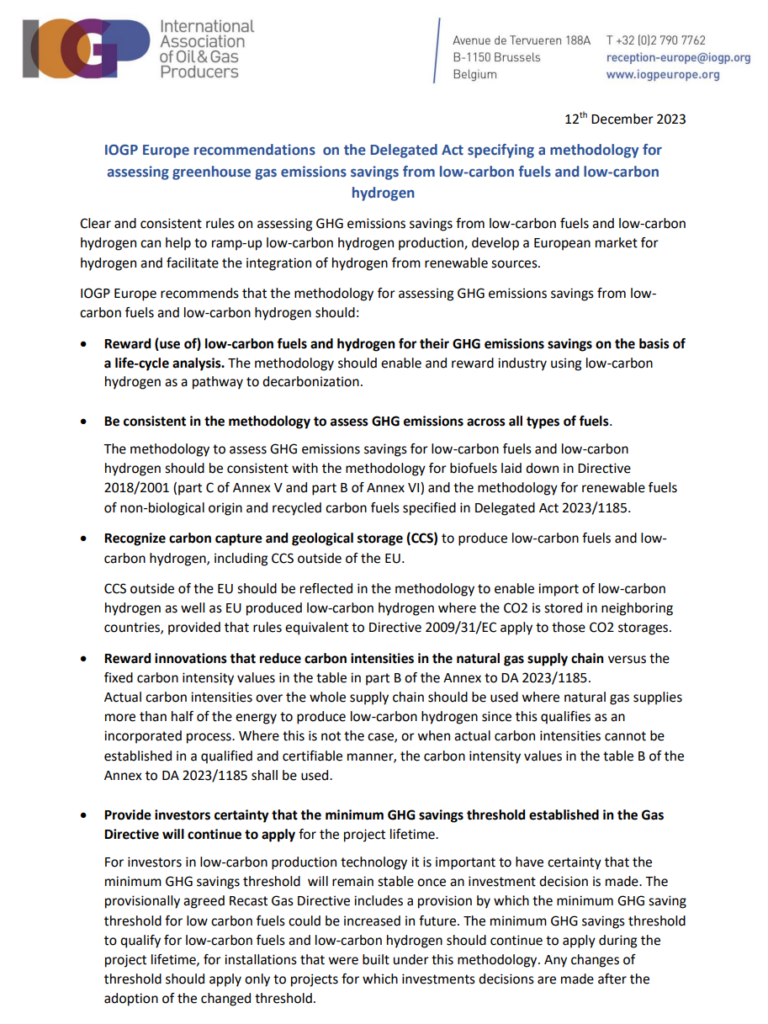
IOGP Europe recommendations on the Delegated Act specifying a methodology for assessing GHG emissions savings from low-carbon fuels and low-carbon hydrogen

Creating a sustainable business case for CCS value chains

IOGP Europe statement on the ECHA proposed PFAS restriction proposal related to the Carbon Capture, Transport and Storage (CCS) Technology

IOGP Europe position on the EU Industrial Carbon Management

IOGP position paper on the European Commission’s public consultation on the EU climate target for 2040

IOGP Europe feedback on Net Zero Industry Act proposal

IOGP position on capital requirements

IOGP response on Competitive Bidding schemes for hydrogen under the Innovation Fund
IOGP response on revamping the Strategic Energy Technology (SET) Plan

IOGP response to the public consultation on the Hydrogen and Decarbonized Gas Market package

IOGP comments to R. W. Howarth and M. Z. Jacobson (2021): How Green is Blue Hydrogen?
Re-Stream – Study on the reuse of oil and gas infrastructure for hydrogen and CCS in Europe

IOGP response to the public consultation on the Renewable Energy Directive (RED) proposal

IOGP response to public consultation on the revised Climate, Energy and Environmental Aid Guidelines (CEEAG)
IOGP Paper on metric to use for 2030 targets
IOGP input to the consultation on the Hydrogen and Gas Market Decarbonization Package

Response to consultation on costs of implementing MRV regulation based on OGMP

IOGP response to the roadmap on the modification of the General Block Exemption Regulation (GBER)

IOGP response to the roadmap and inception impact assessment concerning revision of the 3rd Gas Package

IOGP response to the Inception Impact Assessment on the revision of the Guidelines on State aid for environmental protection and energy (EEAG) 2014-2020

IOGP written input to the consultation “Maritime sector – a green post-COVID future”

What’s Right? What’s Wrong? IOGP comments on the ‘EU Strategy for Energy System Integration’ and ‘A hydrogen strategy for a climate neutral Europe’

IOGP views on State aid for environmental protection and energy (EEAG)

IOGP response to the inception impact assessment concerning the revision of the 2018 Renewable Energy Directive (REDII)
IOGP response to supplementary questions on the EIB Group’s Climate Bank Roadmap 2021-2025

Funding CCS in Europe: key investments for the recovery
IOGP response to the public consultation on the revision of Regulation (EU) 347/2013 on guidelines for TEN-E Regulation
IOGP response to targeted consultation on the revision of Regulation (EU) 347/2013 on guidelines for TEN-E Regulation

IOGP input to the Roadmap on the EU Smart System Integration
IOGP input to the Roadmap on the EU strategy on hydrogen in Europe
IOGP feedback to the Combined Evaluation Roadmap/Inception Impact Assessment on the revision of Regulation (EU) 347/2013 on guidelines for TEN-E

IOGP input to the forthcoming EU Strategy for Energy System Integration

New and old CCS projects in Europe: What’s different this time?
IOGP assessment of National Energy and Climate Plans

Scaling up Hydrogen in Europe
Hydrogen for Europe Pre-study – Key findings
IOGP assessment of draft National Energy and Climate Plans
Hydrogen for Europe
The potential for CCS and CCU in Europe Report to the thirty second meeting of the European Gas Regulatory Forum 5-6 June 2019
CCS: the Innovation Fund and beyond

OGP contribution to the CCS Directive evaluation

One year delays the problem; three years will fix it: Why a three-year postponement of the EU Methane Regulation’s importer requirements is needed

State of the European Union: Europe needs energy optionality to strengthen resilience while advancing the transition
Majority of EU Member States call for postponement and targeted amendments to Methane Regulation
Declining number of announced CO₂ storage projects in Europe highlights gap between EU’s 2030 target and operational reality.
Joint Letter: Europe’s Response to High Energy Prices – Concerns Regarding a Natural Gas Price Cap
EU Methane Regulation Risks Severe Disruption to Europe’s Oil and Gas Supply from 2027
Joint Statement: calling for reducing methane emissions while ensuring EU energy security
EU delivers landmark decision in quest to cut red tape, strengthen competitiveness and security of supply
New Pact for the Mediterranean: an opportunity to foster the region’s energy integration

EU Low-Carbon Hydrogen production rules are not the signal investors were waiting for
Press release: 2040 Climate trajectory requires urgent action on policy enablers
Press release: State Aid Framework for Clean Industrial Deal marks a turn towards pragmatic decarbonization
Press release: Low-carbon fuels methodology envisaged by the Commission will block key hydrogen production pathways
Joint Letter: Accelerating investments in CO₂ infrastructure
Press Release: Roadmap to end Russian energy imports will require policy signals and regulatory adjustments to succeed.

MEP Jeannette Baljeu on the Crucial Role of CCS in Europe’s Industrial Transition
Draghi Report: a pragmatic pathway to Competitiveness, Sustainability, and Resilience
Press release: Recognition of CCS on path to 2050 marks a step change, but approach to low-carbon solutions remains too narrow.

Letter: IOGP Europe recommendations on the Hydrogen and Decarbonized Gas Market Package
Letter: Strong support for an implementable and pragmatic Net Zero Industry Act Article 18 – solutions to make CCS work
Net-Zero Industry Act marks a step change in industrial and climate policy – EU paves way for carbon capture and storage scale-up
Letter: Open, inclusive, and pragmatic Green Deal Industrial Plan for Europe

Europe needs a CO2 storage ambition for 2050
Gas market reform marks a step change in EU approach to the transition
New Re-Stream study assesses the feasibility of transport of hydrogen and CO2 in European gas and oil infrastructure
Letter: Call for a technology-inclusive revision of the TEN-E Regulation
“Hydrogen for Europe” study launch
Towards greater hydrogen production capacity in Europe
Letter: IOGP input on the European Commission’s consultation on the priority list for the development of gas network codes and guidelines for 2021 (and beyond)
Council’s inclusive approach to hydrogen sends strong signal ahead of key legislative year

Letter: 57 industry leaders call for enhancing gas contribution to decarbonisation

Carbon Management Webinars

EU’s hydrogen and energy system vision can only succeed with a more balanced, inclusive approach

Wide industry coalition call for a Hydrogen Strategy inclusive of all clean hydrogen pathways

Joint letter: CCS and CCU for the EU’s Industrial Transition
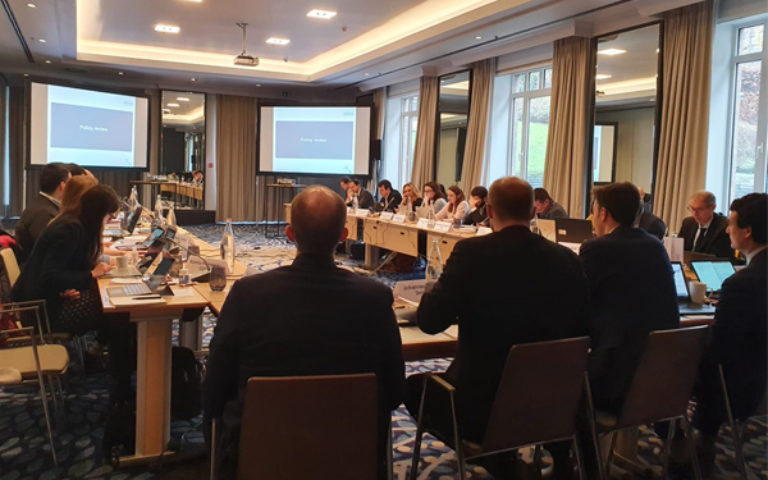
Hydrogen for Europe: 1st Working Group Meeting


Takeaways from the Industry Summit: An energy system fit to support European competitiveness

Carbon Capture Europe Summit 2026 | Rotterdam | 11-12 March 2026








The Europe CCUS & Hydrogen Decarbonisation Summit
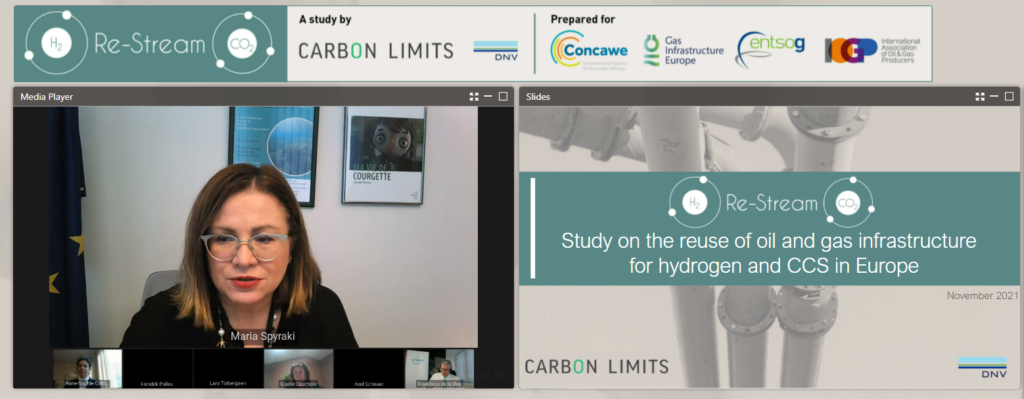
Re-Stream Study Launch Event
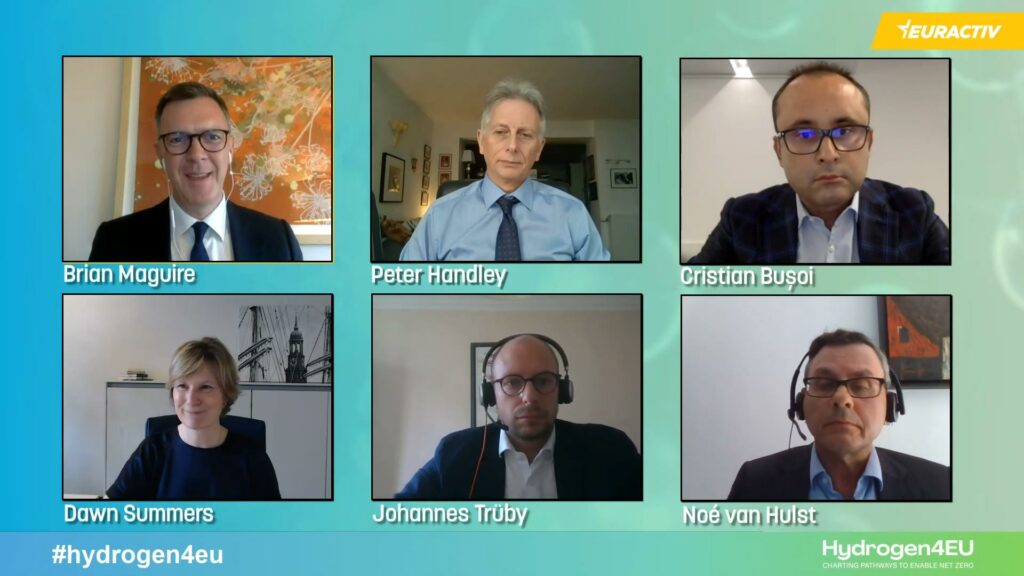
Hydrogen4EU Launch Event

Sustainable finance: investor, oil and gas sector and global perspectives
Carbon Management Webinars

Sustainable finance: non-financial disclosure for the oil and gas sector and EU taxonomy in practice