
One year delays the problem; three years will fix it: Why a three-year postponement of the EU Methane Regulation’s importer requirements is needed
Brussels, 2 October, 2026 – The Commission’s intention to postpone the EU Methane Regulation’s importer requirements recognises that the January 2027 deadline is not workable. But a one-year postponement is not enough. Three years are needed to complete the compliance framework while protecting Europe’s access to secure and affordable energy.
To address the risk of non-compliance, the postponement must cover all importer obligations due in 2027 and 2028 under Articles 28(1)(2) and 29(1), and the equivalent requirements for domestic producers set by Article 12(3).
However, given the delays witnessed so far, moving the deadline by a mere twelve months risks recreating the same problem in late 2027.
The current energy crisis raises the stakes, but it is not the only reason for postponement. The core issue is an incomplete compliance framework that will take time to implement globally.
Three reasons why three years – not one – are needed:
1. Too much of the compliance system is missing – and much of it is outside importers’ control: Four workstreams, as seen below, still need to come together globally: production of significant volumes of oil and gas that meet the requirements for monitoring, reporting and verification (MRV) ‘equivalence’; independent verification protocols and capacity must be established; verifiers must be accredited; and certification solutions must be recognised and scaled up.
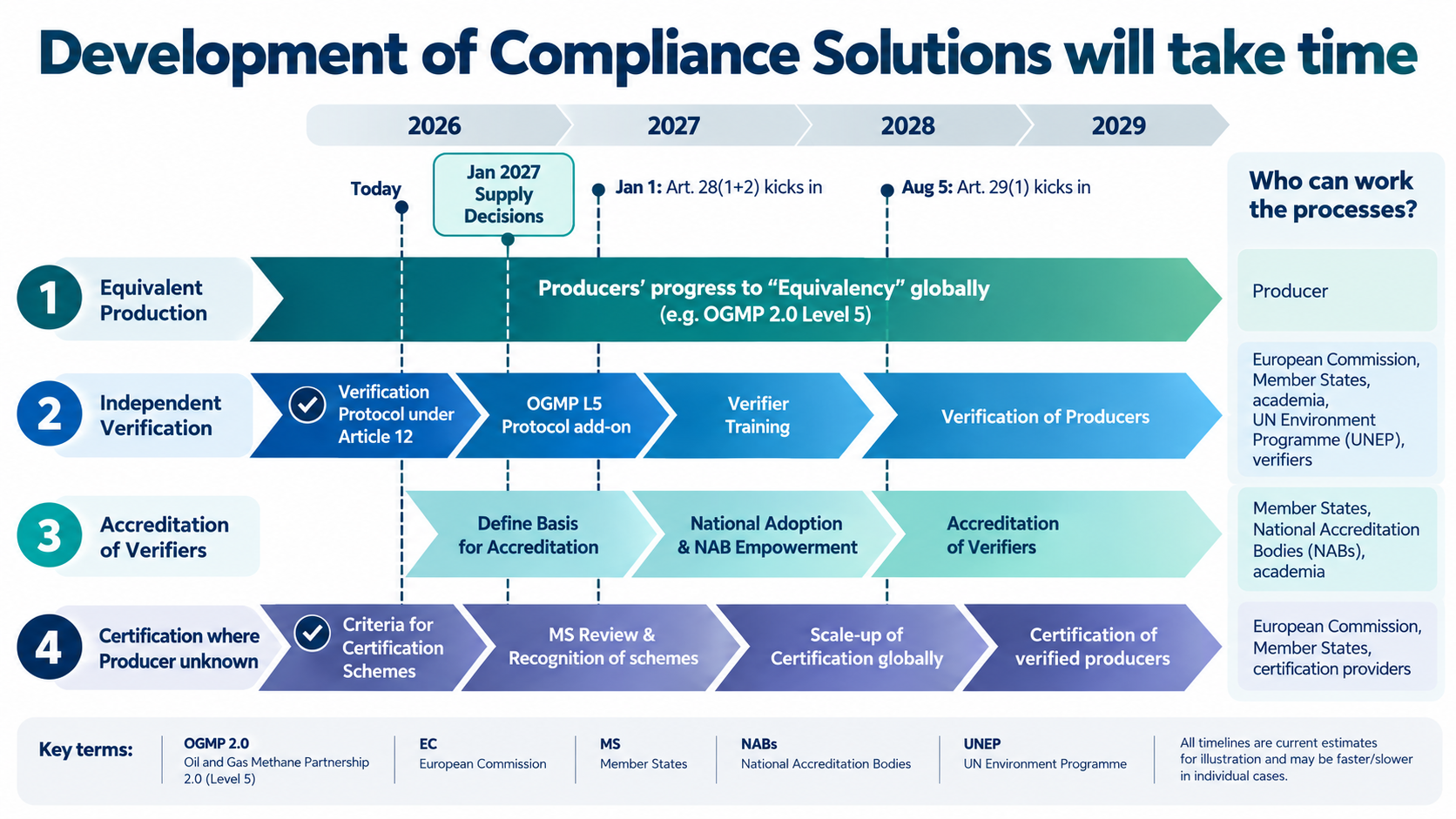
These are not systems importers can create themselves or accelerate simply by investing more. They depend on action by the Commission, Member States, national accreditation bodies, UNEP, verifiers, certification providers and producers.
2. These steps are sequential – and take time to scale, globally: Accreditation cannot happen before the basis for accreditation is clear; large-scale verification requires enough accredited and trained verifiers; and certification depends on verified production and recognised solutions available globally, at scale. Companies need time not only for the framework to be completed, but for these systems to become globally available.
3. Three years must be an active implementation period – not a pause: The aim should be to solve the problem once, not create another cliff edge in twelve months. Clear milestones and responsibilities should drive completion of the framework, build verification capacity and expand the pool of supply able to demonstrate compliance.
“A one-year delay gives Europe breathing space. Three years gives policymakers time to fix the underlying problem,” said François-Régis Mouton de Lostalot, Managing Director, IOGP Europe. “Only this would give industry and importers the legal certainty they need – and households and businesses confidence that this will be resolved properly. We need a Regulation that delivers on an ambition we all support without putting the EU’s energy security and affordability at risk.”
The EU Deforestation Regulation offers both encouragement and a warning: the experience shows that targeted amendments can be agreed quickly, but after a one-year postponement in 2024, a further delay was needed in 2025 as implementation challenges persisted.
“Europe should learn from this experience. Give the EU Methane Regulation enough time now to get implementation right – rather than return to the same problem twelve months from now,” concluded Mouton de Lostalot.
