IOGP Europe response to the European Commission’s consultation on the revised Maritime Spatial Planning Directive / Ocean Act
Executive summary
IOGP Europe recognises the value of maritime spatial planning for Europe’s busy seas and supports the objective to protect and enhance the health of the seas, whilst simultaneously using the marine environment for important and responsibly operated commercial purposes, including shipping and energy production, transport and storage, which are critical for Europe’s energy security and resilience. We encourage the Commission to ensure that the revised Maritime Spatial Planning Directive / Ocean Act take account of the full range of legitimate activities that occur in the marine environment.
IOGP Europe notes that recent regulatory focus has been on the interactions of commercial fisheries, aquaculture, and offshore wind farm developments with ecosystem protection in Marine Protected Areas (MPAs). The marine environment is used for much more than these important, but limited, list of activities. IOGP Europe notes that the Ocean Pact describes the Blue Economy as all sustainable economic activities related to oceans, seas and coasts, and should encompass both traditional and emerging maritime sectors.
The subsurface geology below the seabed has been largely overlooked in MSP discussions but plays a critical role for a number of economic and net-zero activities. IOGP Europe encourages the Commission to fully consider the following activities in developing the proposed Ocean Act, recognising that seabed sediments and deeper geology underlying the marine environment have critical uses:
- Existing or under-development oil and gas infrastructure (platforms, subsea pipelines and equipment etc), and requirements for their operation and maintenance.
- Potential future hydrocarbon and natural hydrogen exploration and production activities.
- Oil and gas infrastructure decommissioning.
- Carbon capture and storage (CCS) in depleted hydrocarbon reservoirs and saline aquifers.
- Natural gas (and potentially hydrogen) storage, which is critical for energy system resilience.
We welcome the objective to better support cross-border and cross-sector coordination and hope this will enable implementation of consistent, proportionate and effective impact mitigation and restoration measures across all sea users, sectors and jurisdictions.
IOGP Europe seeks to ensure that the Act will integrate requirements with the established regional seas conventions (e.g., OSPAR, ASCOBAM, etc), and that the proposed coordinated approach will consolidate and simplify, rather than increase administrative burden.
Details
1. Oil and gas infrastructure and hydrocarbon production
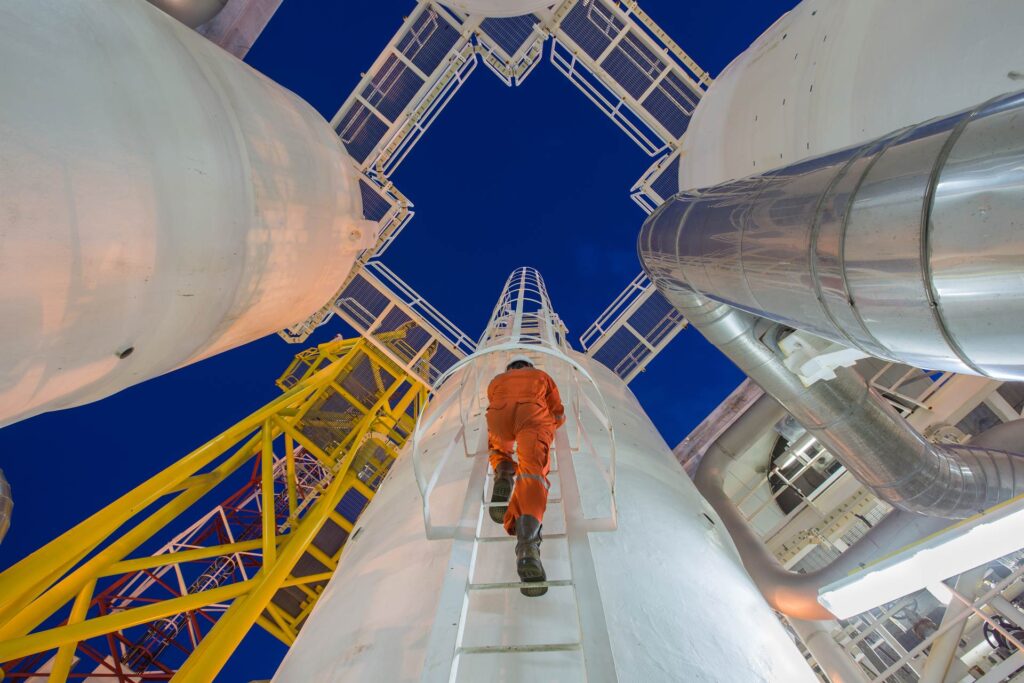
Offshore oil and gas production in the EU and surrounding countries is an important source of hydrocarbons for both energy and chemical feedstocks, thereby playing an important role in contributing to the EU’s security of energy and food supply, and resilience. In the North Sea there are about 200 platforms and floating production, storage and offloading units (FPSOs), plus associated subsea pipelines, wells, and other infrastructure.
The existing infrastructure places constraints on other uses (e.g. commercial fishing) in the immediate vicinity of the platforms and has implications for the types of fishing undertaken near subsea pipelines (e.g. bottom trawling). Future development of hydrocarbon resources in the North Sea is most likely to be in-fill and tiebacks to existing assets, albeit development of significant new reserves is also plausible in some areas, such as northern Norway and the UK west of Shetland.
In the EU, hydrocarbons are being explored or produced in several areas offshore Bulgaria, Croatia, Cyprus, Denmark, Greece, Italy, the Netherlands, and Romania. Significant new hydrocarbon exploration and development projects are underway in the eastern Mediterranean and Black Sea, with new production anticipated in the future. Spatial planning should consider the presence of existing, ongoing or future developments of oil and gas assets, including
platforms, wells and subsea pipelines and equipment to ensure no adverse effects from other activities.
Potential impacts and benefits resulting from spatial plans should be evaluated over a suitable timeframe, especially when disrupting existing users. Additionally, outcomes should also be assessed against unintended consequences of new policies. As an example, re-routing of a major shipping lane could lead to higher emissions and costs, therefore being in contradiction to EU Fit for 55 policies for the shipping sector when allowing for a new offshore wind energy system in an existing shipping lane. A net emissions and economic impact analysis would ensure seamless cross sectoral policy integration.
2. Oil and gas infrastructure decommissioning and/or repurposing
Many of the North Sea oil and gas reservoirs are maturing and will be decommissioned in the coming decades. Infrastructure decommissioning in some other EU offshore hydrocarbon basins will follow. Removal, repurposing, or other decommissioning activities need space to be safely undertaken (IOGP, 2021). The location and timing of anticipated decommissioning / repurposing should be considered during maritime spatial planning, since these activities may impose time-limited constraints on other activities in their vicinity and on the need to coordinate supply chain activities. Any new policy initiatives stemming from the Maritime Spatial Planning Directive and the Ocean Act relating to decommissioning should be consistent with existing European and regional regulatory frameworks, including the EU Offshore Safety Directive, OSPAR (in particular Decision 98/3), and other Regional Seas Conventions in Europe.
3. Carbon capture and storage (CCS)
Carbon capture and storage (CCS) will play a critical role in helping the EU achieve its goal to be net-zero by 2050, particularly for hard-to-abate sectors where electrification is currently not feasible. Geological storage of the CO2 is typically in depleted gas reservoirs, and in deep saline aquifers. In Europe the greatest potential for CO2 storage is in the depleted reservoirs under the North Sea, and in the saline aquifers in the same region. Opportunities also exist in the Mediterranean and Black Sea areas.
CCS infrastructure typically includes deep injection wells (typically to greater than 1km below seabed), supplied either through seabed pipelines from the carbon capture systems on land, or transported by ship. CCS infrastructure may incorporate a (new or repurposed) platform at sea to offload CO2 into the injection well(s) and to house compressors etc. During and following injection of CO2 access for monitoring, measurement and verification (MMV) of the effectiveness of the geological storage is undertaken to demonstrate containment (EU, 2009; ISO, 2026).
CCS operations may be compatible with other uses, such as fixed or floating wind farms, but are likely to impose phasing constraints. Wind farms may be successfully developed around an existing CCS infrastructure, but it is likely to be more challenging the develop CCS within the boundaries of an existing wind farm. Maritime spatial plans should take into account the potential for development of geological CO2 storage deep below the seabed of various European seas.
4. Gas storage
Natural gas storage is an important part of a resilient energy system, whereby natural gas is imported and stored in periods of low demand (i.e., summer where minimum space heating is required), so it is available for use in high demand periods, such as winter. Gas storage typically occurs in depleted natural gas reservoirs, saline aquifers and in salt caverns. A number of the facilities used for temporary natural gas storage are located offshore, deep under the North Sea seabed. In the future other gases may be stored in a similar way, including co-location models for hydrogen. Spatial planning should identify and assess both current, and potential future, geological gas storage infrastructure.
Conclusions
The geological strata beneath a number of European seas are critical for hydrocarbon supply, and for the geological storage of CO2 and other gases. Maritime spatial planning needs to take account of the fact that the marine environment overlies important natural geological resources and should have regard to those uses of the geology, alongside the aquatic ecosystems, fauna and flora, and other maritime activities in the overlying water column.
Multiple uses of the geological domain and the overlying aquatic environment are possible. However, it will require specific analysis and evaluation of both spatial and temporal constraints on access to the deep subsurface, and for exploration, development, production, decommissioning or repurposing of oil and gas infrastructure on the seabed in the coming decades.
The Crown Estate’s Co-location Forum for the UK seabed provides an interesting model demonstrating these considerations (Crown Estate, 2026). Integrated offshore energy systems should be enabled with the spatial planning frameworks, allowing co-location of a variety of energy infrastructure (offshore wind, CCS, hydrocarbons, hydrogen) and its transport. This would further incentivise a diversified energy mix, in line with Europe’s strategic priorities. The EU Ocean Act should furthermore safeguard efficient maritime transport and energy flows, recognising the critical role of shipping, ports and trading systems.
IOGP Europe remains committed to provide constructive input to the European Commission on maritime spatial planning to ensure full consideration and evaluation of sustainable use of the full range of services provided by marine basins.
References
Crown Estate, 2026. Offshore Wind and CCUS Co-Location Forum | The Crown Estate
IOGP, 2021. Offshore oil and gas pipeline decommissioning briefing. IOGP Report 632, IOGP, London.
https://iogp.sharepoint.com/sites/Resources/Publications/632.pdf
ISO 27914:2026. Carbon dioxide capture, transportation and storage – Geological storage.
EU, 2009. DIRECTIVE 2009/31/EC OF THE EUROPEAN PARLIAMENT AND OF THE COUNCIL of 23 April 2009 on the geological storage of carbon dioxide and amending Council Directive 85/337/EEC, European Parliament and Council Directives 2000/60/EC, 2001/80/EC, 2004/35/EC, 2006/12/EC, 2008/1/EC and Regulation (EC) No 1013/2006.
- Publications
- News
- Events
IOGP Europe’s views on the revision of the Oil Stocks Directive
IOGP Europe’s Response to the Open Public Consultation on CSDDD Guidelines

IOGP Europe position on Industrial Accelerator Act and recommendations for modifications

IOGP Europe response to the European Commission’s consultation on the revised Sector Agnostic ESRS

IOGP Europe’s response to the European Chemical Agency’s (ECHA) Socio-Economic Committee (SEAC) draft Opinion of the proposed ‘Universal-PFAS

Socio-Economic Analysis for a Reach Restriction Proposal on PFAS in the Upstream Oil & Gas, Oil Refining and Fuel Distribution Sectors, and in Carbon Capture and Storage
IOGP Europe’s Response to the Revision of national targets and flexibilities in the EU climate policy framework after 2030

Extraordinary taxation risks undermining Europe’s security of supply and energy autonomy

Joint Letter: Urgent call for targeted amendments to the Methane Emissions Reduction Regulation through the EU simplification agenda including the stop-the-clock

IOGP Europe response to EU Taxonomy Consultation on the Technical Screening Criteria Delegated Act amending the Climate Delegated Act
IOGP Europe recommendations on workable solutions for the upcoming CO2 markets and infrastructure legislative proposal
IOGP Europe’s response to the European Commission’s Call for Evidence on EU Arctic Policy

Joint Letter in the context of Europe’s Response to High Energy Prices – Concerns Regarding a Natural Gas Price Cap

Delivering on the Omnibus I simplification mandate: IOGP Europe position on the draft Sector-Agnostic European Sustainability Reporting Standards (ESRS)

Upstream Oil & Gas and CCS operations in Europe: Perspective on a proposed EU Universal-PFAS Restriction

IOGP Europe response to the EU Taxonomy – review of Climate and Environmental Delegated Acts consultation

Joint industry letter ahead of the plenary vote on the First Omnibus Simplification Package
Amended ESRS Exposure Draft July 2025 Public Consultation Survey

IOGP Europe response to ESMA Consultation on the draft technical standards under the ESG Ratings Regulation

Omnibus Simplification Package: Open Letter with Eurogas and FuelsEurope
Simplification Omnibus Package: towards a proportionate, coherent and efficient sustainability framework for European competitiveness

Joint Position Paper – Extending the ‘Stop-the-Clock’ Initiative to Wave 1 Companies

IOGP Europe Response to the Consultation on the Review of the Taxonomy Climate Delegated Act
IOGP Europe recommendations for the Omnibus proposal

Joint Trade Association Statement: Towards EU due diligence that works for all
EU Taxonomy Stakeholder Request Mechanism
IOGP consultation response to draft EFRAG Value Chain Implementation Guidance (VCIG)
Download
IOGP consultation response: Rationalisation of reporting requirements
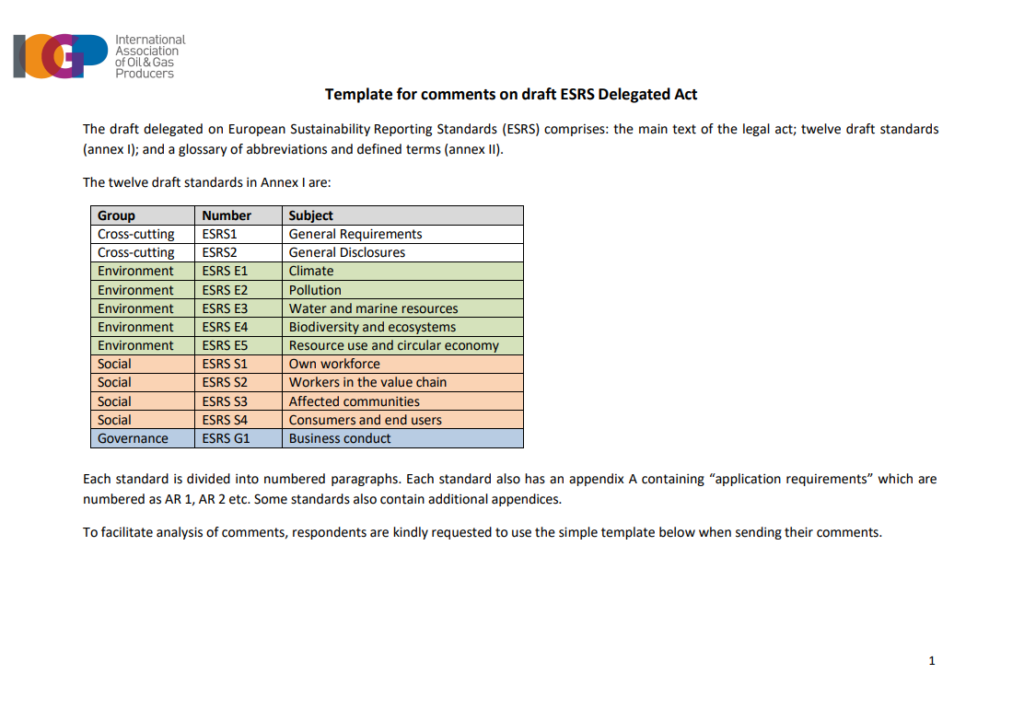
Joint industry statement on the EU Taxonomy
IOGP Europe views on the EU corporate sustainability reporting framework
IOGP input on the EU Commission’s public consultation on the EU Taxonomy Delegated Acts
IOGP position on capital requirements
IOGP position on the Corporate Sustainability Due Diligence Directive (CSDDD)
IOGP feedback on the Platform on Sustainable Finance’s draft report on preliminary recommendations for technical screening criteria for the EU taxonomy

IOGP feedback on the Platform on Sustainable Finance’s draft report on social taxonomy
IOGP feedback on the Platform on Sustainable Finance’s draft proposal for an extended taxonomy to support economic transition
IOGP position on the European Commission proposal on the update of the Corporate Sustainability Reporting Directive
FuelsEurope and IOGP position on the Draft Delegated Regulation on taxonomy related disclosures by undertakings reporting non-financial information
IOGP response to the roadmap on the modification of the General Block Exemption Regulation (GBER)
Response to consultation on proposal for an Initiative on Sustainable Corporate Governance
Response form for the Consultation Paper on the Draft advice to European Commission under Article 8 of the Taxonomy Regulation
IOGP input to the Commission’s Delegated Regulation establishing the technical screening criteria for economic activities contributing substantially to climate change mitigation or climate change adaptation
IOGP input to the IIA on the EC’s Delegated Regulation on taxonomy-related disclosures by undertakings reporting non-financial information
IOGP response to the consultation on ESG disclosures under Regulation (EU) 2019/2088
IOGP response to consultation on the renewed Sustainable Finance strategy
IOGP response to the public consultation on the revision of the NFRD
Sustainability reporting guidance for the oil and gas industry
IOGP Initial Feedback to the Taxonomy: Final report of the Technical Expert Group on Sustainable Finance
Response to the inception impact assessment “Commission Delegated Regulation on a climate change mitigation and adaptation taxonomy”

IOGP input to the Impact Inception Assessment on the Revision of the NFRD
Call for feedback on TEG report on EU Taxonomy
IOGP response to the European Commission’s package on sustainable finance Call for a “Talanoa Platform” to guarantee a smart, inclusive and technology-neutral taxonomy
Joint Letter: Europe’s Response to High Energy Prices – Concerns Regarding a Natural Gas Price Cap
New interactive Data Room goes live

IOGP Europe Welcomes 3 New Board Members

Press Release: European Parliament backs meaningful simplification of sustainability rules

Chris Walker (ExxonMobil), newly appointed Chair of IOGP Europe’s Communications Subcommittee

Building energy bridges between Brazil and the EU
IOGP Europe signs the Antwerp Declaration

IOGP welcomes ROMGAZ
Letter: Industry views regarding the proposal to establish a permanent demand aggregation and joint purchasing mechanism through the Recast Gas Regulation
Letter: The EU’s Corporate Sustainability Due Diligence Directive (CSDDD) – IOGP Europe and FuelsEurope recommendations in view of the trialogue negotiations
Inclusion of gas in the Taxonomy Regulation supports EU ambition to reach climate neutrality by 2050

Sustainable Finance Webinars
IOGP Statement on the EU Recovery Plan