IOGP Europe response to the EU Taxonomy – review of Climate and Environmental Delegated Acts consultation
IOGP Europe welcomes the review of the Climate and Environmental Delegated Acts. We support the Commission’s objective to simplify the EU Taxonomy in line with the Competitiveness Compass and the Omnibus I simplification package, and we provide evidence focused on improving clarity, legal certainty and proportionality. This submission responds to the Commission’s call for evidence on the review of both the Climate and Environmental Delegated Acts.
Experience applying the Technical Screening Criteria (TSC) shows that many elements remain difficult to operationalize, especially where requirements are granular, ambiguous or based on assumptions that do not reflect how projects are assessed, permitted or managed in jurisdictions with different regulatory systems. Companies also face disproportionate administrative burdens in Do No Significant Harm (DNSH) assessments, in particular in early project stages when data is limited and also on small scale/geographically distributed assets and activities that are not core to business operations or significant to environmental impact. For example, early-stage Life Cycle Assessments (LCAs) and long-term climate projections (e.g. estimating conditions in 2050 or 2060) are often not feasible at the early stages of a project, such as during conception or permitting stages. This also affects activities with a very small environmental footprint, such as individual charging points, which are subject to the same criteria as large low-carbon public transport infrastructure (such as tram or metro systems) under Activity 6.15, despite their non-comparable impact.
Addressing these issues through clearer, more proportionate criteria aligned with established national frameworks would improve consistency and reduce unnecessary complexity while maintaining environmental integrity. These challenges reflect consistent implementation issues, where overly detailed criteria and unclear expectations increase compliance risks without delivering better environmental outcomes.
This submission outlines practical adjustments to strengthen usability, support investment, and ensure alignment with evolving EU legislation. We focus on improving interoperability with strong non-EU regulatory systems and on ensuring that the criteria reflect how energy and industrial projects are planned, permitted and operated in practice across different regions and technologies. We recommend clearer guidance on Minimum Safeguards applied at the reporting-entity level and a more explicit proportionality principle to avoid disproportionate requirements for activities incidental or peripheral to an undertaking core business. We also strongly encourage the Commission to ensure technology neutrality across activities, avoiding selective criteria that create inconsistent burdens.
Download the document to see our full list of recommendations.

- Publications
- News
- Events

IOGP Europe’s Response to the Open Public Consultation on CSDDD Guidelines
IOGP Europe response to the European Commission’s consultation on the revised Maritime Spatial Planning Directive / Ocean Act

IOGP Europe position on Industrial Accelerator Act and recommendations for modifications

IOGP Europe response to the European Commission’s consultation on the revised Sector Agnostic ESRS

IOGP Europe’s response to the European Chemical Agency’s (ECHA) Socio-Economic Committee (SEAC) draft Opinion of the proposed ‘Universal-PFAS

Socio-Economic Analysis for a Reach Restriction Proposal on PFAS in the Upstream Oil & Gas, Oil Refining and Fuel Distribution Sectors, and in Carbon Capture and Storage

IOGP Europe response to EU Taxonomy Consultation on the Technical Screening Criteria Delegated Act amending the Climate Delegated Act

Delivering on the Omnibus I simplification mandate: IOGP Europe position on the draft Sector-Agnostic European Sustainability Reporting Standards (ESRS)

Joint industry letter ahead of the plenary vote on the First Omnibus Simplification Package

Amended ESRS Exposure Draft July 2025 Public Consultation Survey

IOGP Europe response to ESMA Consultation on the draft technical standards under the ESG Ratings Regulation

Omnibus Simplification Package: Open Letter with Eurogas and FuelsEurope
Simplification Omnibus Package: towards a proportionate, coherent and efficient sustainability framework for European competitiveness

Joint Position Paper – Extending the ‘Stop-the-Clock’ Initiative to Wave 1 Companies

IOGP Europe Response to the Consultation on the Review of the Taxonomy Climate Delegated Act
IOGP Europe recommendations for the Omnibus proposal

Joint Trade Association Statement: Towards EU due diligence that works for all
EU Taxonomy Stakeholder Request Mechanism
IOGP consultation response to draft EFRAG Value Chain Implementation Guidance (VCIG)
Download
IOGP consultation response: Rationalisation of reporting requirements
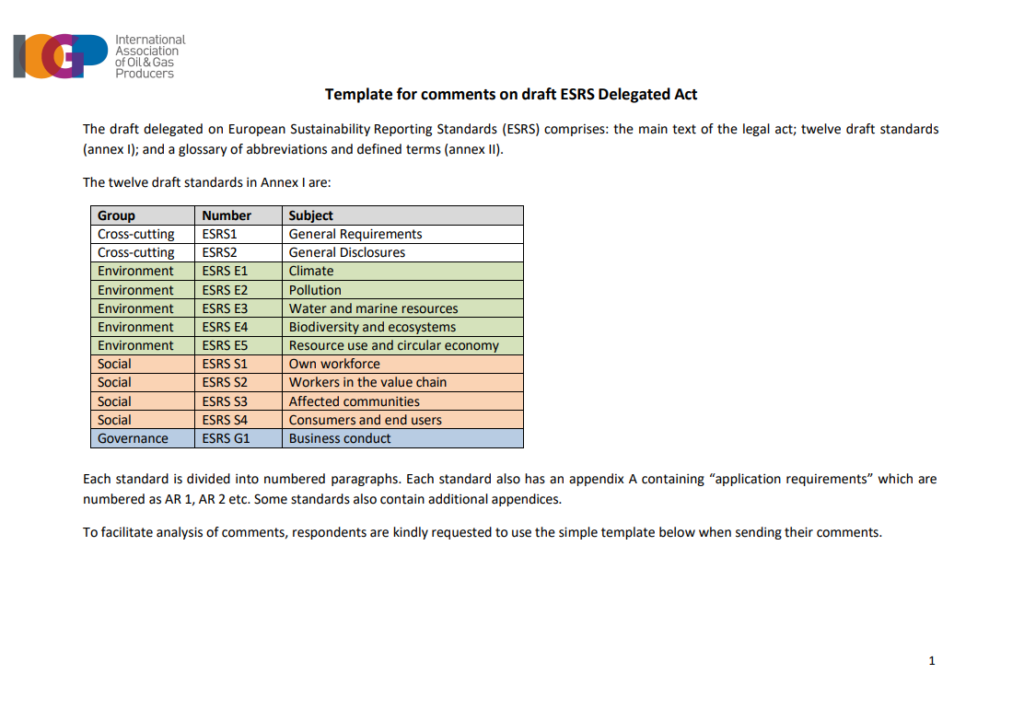
Joint industry statement on the EU Taxonomy
IOGP Europe views on the EU corporate sustainability reporting framework
IOGP input on the EU Commission’s public consultation on the EU Taxonomy Delegated Acts
IOGP position on capital requirements
IOGP position on the Corporate Sustainability Due Diligence Directive (CSDDD)
IOGP feedback on the Platform on Sustainable Finance’s draft report on preliminary recommendations for technical screening criteria for the EU taxonomy

IOGP feedback on the Platform on Sustainable Finance’s draft report on social taxonomy

IOGP feedback on the Platform on Sustainable Finance’s draft proposal for an extended taxonomy to support economic transition
IOGP position on the European Commission proposal on the update of the Corporate Sustainability Reporting Directive
FuelsEurope and IOGP position on the Draft Delegated Regulation on taxonomy related disclosures by undertakings reporting non-financial information
IOGP response to the roadmap on the modification of the General Block Exemption Regulation (GBER)
Response to consultation on proposal for an Initiative on Sustainable Corporate Governance
Response form for the Consultation Paper on the Draft advice to European Commission under Article 8 of the Taxonomy Regulation
IOGP input to the Commission’s Delegated Regulation establishing the technical screening criteria for economic activities contributing substantially to climate change mitigation or climate change adaptation
IOGP input to the IIA on the EC’s Delegated Regulation on taxonomy-related disclosures by undertakings reporting non-financial information
IOGP response to the consultation on ESG disclosures under Regulation (EU) 2019/2088
IOGP response to consultation on the renewed Sustainable Finance strategy
IOGP response to the public consultation on the revision of the NFRD
Sustainability reporting guidance for the oil and gas industry
IOGP Initial Feedback to the Taxonomy: Final report of the Technical Expert Group on Sustainable Finance
Response to the inception impact assessment “Commission Delegated Regulation on a climate change mitigation and adaptation taxonomy”

IOGP input to the Impact Inception Assessment on the Revision of the NFRD
Call for feedback on TEG report on EU Taxonomy
IOGP response to the European Commission’s package on sustainable finance Call for a “Talanoa Platform” to guarantee a smart, inclusive and technology-neutral taxonomy

Press Release: European Parliament backs meaningful simplification of sustainability rules
Letter: The EU’s Corporate Sustainability Due Diligence Directive (CSDDD) – IOGP Europe and FuelsEurope recommendations in view of the trialogue negotiations
Inclusion of gas in the Taxonomy Regulation supports EU ambition to reach climate neutrality by 2050

Sustainable Finance Webinars