CSDDD Guidelines: IOGP Europe recommendations for workable implementation
The Corporate Sustainability Due Diligence Directive (CSDDD) was created to strengthen how companies identify and address adverse human rights and environmental impacts in their operations, subsidiaries and chains of activities. Its effectiveness depends on requirements that companies can apply across complex business relationships and jurisdictions.
The Omnibus I amendments simplified these requirements, including through initial risk scoping based solely on reasonably available information and in-depth assessments focused on areas where adverse impacts are most likely and severe. The European Commission’s forthcoming Guidelines should explain how to apply these provisions consistently, without introducing additional obligations.
IOGP Europe’s position paper identifies six priorities for the Guidelines:
- Assess the adequacy of processes and measures. An adverse impact should not, by itself, establish a failure to meet due diligence obligations. Supervisory assessments should consider reasonable, documented and good-faith decisions.
- Recognise existing systems. Companies should be able to build on risk management, supplier assessments, environmental and social impact assessments, and grievance mechanisms where these meet the Directive’s requirements.
- Clarify risk scoping. Guidance should distinguish initial scoping from in-depth assessment, avoid expectations of exhaustive mapping of every tier, and reflect differences in control, leverage and access to information.
- Address cross-border legal constraints. Companies need guidance on conflicting legal requirements, confidentiality, sanctions and restricted access to information, including the use of credible alternative sources.
- Keep contracts and verification proportionate. Model clauses should remain voluntary. Industry initiatives and third-party assurance should count as relevant evidence without becoming mandatory compliance tools or automatic safe harbours.
- Clarify responsibility and remediation. Guidance should distinguish between causing, jointly causing and being linked to an impact. Disengagement should remain a last resort, taking account of potential consequences for workers, communities and the environment.
We therefore call for a true stakeholder consultation or implantation dialogue on the draft Guidelines to test their practical application before final publication.
Read the full position paper here
- Publications
- News
- Events
IOGP Europe responds to EFRAG’s consultation on sustainability reporting standards for non-EU groups (ESRS 40a)

IOGP Europe’s Response to the Open Public Consultation on CSDDD Guidelines
IOGP Europe response to the European Commission’s consultation on the revised Maritime Spatial Planning Directive / Ocean Act

IOGP Europe position on Industrial Accelerator Act and recommendations for modifications

IOGP Europe response to the European Commission’s consultation on the revised Sector Agnostic ESRS

IOGP Europe’s response to the European Chemical Agency’s (ECHA) Socio-Economic Committee (SEAC) draft Opinion of the proposed ‘Universal-PFAS

Socio-Economic Analysis for a Reach Restriction Proposal on PFAS in the Upstream Oil & Gas, Oil Refining and Fuel Distribution Sectors, and in Carbon Capture and Storage

IOGP Europe response to EU Taxonomy Consultation on the Technical Screening Criteria Delegated Act amending the Climate Delegated Act

Delivering on the Omnibus I simplification mandate: IOGP Europe position on the draft Sector-Agnostic European Sustainability Reporting Standards (ESRS)

IOGP Europe response to the EU Taxonomy – review of Climate and Environmental Delegated Acts consultation

Joint industry letter ahead of the plenary vote on the First Omnibus Simplification Package

Amended ESRS Exposure Draft July 2025 Public Consultation Survey

IOGP Europe response to ESMA Consultation on the draft technical standards under the ESG Ratings Regulation

Omnibus Simplification Package: Open Letter with Eurogas and FuelsEurope
Simplification Omnibus Package: towards a proportionate, coherent and efficient sustainability framework for European competitiveness

Joint Position Paper – Extending the ‘Stop-the-Clock’ Initiative to Wave 1 Companies

IOGP Europe Response to the Consultation on the Review of the Taxonomy Climate Delegated Act
IOGP Europe recommendations for the Omnibus proposal

Joint Trade Association Statement: Towards EU due diligence that works for all
EU Taxonomy Stakeholder Request Mechanism
IOGP consultation response to draft EFRAG Value Chain Implementation Guidance (VCIG)
Download
IOGP consultation response: Rationalisation of reporting requirements
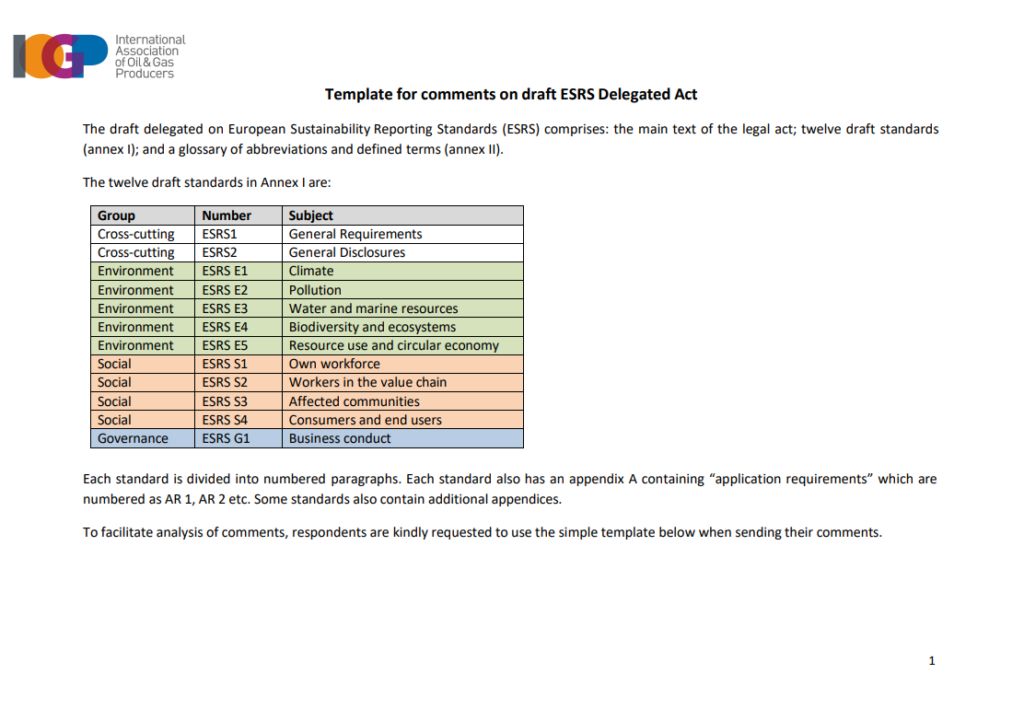
Joint industry statement on the EU Taxonomy
IOGP Europe views on the EU corporate sustainability reporting framework
IOGP input on the EU Commission’s public consultation on the EU Taxonomy Delegated Acts
IOGP position on capital requirements
IOGP position on the Corporate Sustainability Due Diligence Directive (CSDDD)
IOGP feedback on the Platform on Sustainable Finance’s draft report on preliminary recommendations for technical screening criteria for the EU taxonomy

IOGP feedback on the Platform on Sustainable Finance’s draft report on social taxonomy
IOGP feedback on the Platform on Sustainable Finance’s draft proposal for an extended taxonomy to support economic transition
IOGP position on the European Commission proposal on the update of the Corporate Sustainability Reporting Directive
FuelsEurope and IOGP position on the Draft Delegated Regulation on taxonomy related disclosures by undertakings reporting non-financial information
IOGP response to the roadmap on the modification of the General Block Exemption Regulation (GBER)
Response to consultation on proposal for an Initiative on Sustainable Corporate Governance
Response form for the Consultation Paper on the Draft advice to European Commission under Article 8 of the Taxonomy Regulation
IOGP input to the Commission’s Delegated Regulation establishing the technical screening criteria for economic activities contributing substantially to climate change mitigation or climate change adaptation
IOGP input to the IIA on the EC’s Delegated Regulation on taxonomy-related disclosures by undertakings reporting non-financial information
IOGP response to the consultation on ESG disclosures under Regulation (EU) 2019/2088
IOGP response to consultation on the renewed Sustainable Finance strategy
IOGP response to the public consultation on the revision of the NFRD
Sustainability reporting guidance for the oil and gas industry
IOGP Initial Feedback to the Taxonomy: Final report of the Technical Expert Group on Sustainable Finance
Response to the inception impact assessment “Commission Delegated Regulation on a climate change mitigation and adaptation taxonomy”

IOGP input to the Impact Inception Assessment on the Revision of the NFRD
Call for feedback on TEG report on EU Taxonomy
IOGP response to the European Commission’s package on sustainable finance Call for a “Talanoa Platform” to guarantee a smart, inclusive and technology-neutral taxonomy

Press Release: European Parliament backs meaningful simplification of sustainability rules
Letter: The EU’s Corporate Sustainability Due Diligence Directive (CSDDD) – IOGP Europe and FuelsEurope recommendations in view of the trialogue negotiations
Inclusion of gas in the Taxonomy Regulation supports EU ambition to reach climate neutrality by 2050

Sustainable Finance Webinars