Call to enable CO₂ Storage in the Baltic Sea Region under the Helsinki Convention
Dear Contracting Parties to the Helsinki Convention and HELCOM Secretariat,
We, the undersigned organisations across, manufacturing sectors, sector associations, civil society organisations, and research institute underline the critical importance of enabling CO2 storage in the Baltic Sea under the Helsinki Convention. While we welcome HELCOM's efforts to seek a legal review in support of policy discussions on carbon capture and storage (CCS) in the Baltic Sea Area, we are concerned that this process alone will not unlock geological carbon storage in this area in the near term.
Additional action by the Contracting Parties will therefore be necessary.
CCS is widely recognised as an essential component to achieve Europe's climate objectives and preserve the competitiveness of European industry.
The Industrial Carbon Management Strategy and the Net-Zero Industry Act (NZIA) set out a vision of a single European market for CO₂ transport and storage services. Achieving this vision requires removing the legal and regulatory barriers hindering the development of CO₂ transport and storage infrastructure across Europe.
Access to environmentally sound and safe geological carbon storage will be critical for many countries in the Baltic Sea region, particularly to support the decarbonisation of energy-intensive industries with significant process emissions. Moreover, several Member States have limited suitable geological formations for permanent storage and will therefore depend on access to storage capacity elsewhere. The Baltic Sea Area has the potential to provide such capacity and can play an important role in supporting European decarbonisation efforts.
Facilitating access to storage capacity is also important in light of Article 20 of the NZIA, which establishes a Union-wide objective of at least 50 million tonnes of annual CO₂ injection capacity by 2030. Several Contracting Parties to the Helsinki Convention host obligated entities that are required to contribute to this target and will need access to sufficient CO₂ storage capacity across Europe.
However, the legal framework under the Helsinki Convention presents challenges to the development of offshore CO₂ storage projects in the Baltic Sea Area. As a result, potential storage resources remain inaccessible, investment in storage infrastructure stalls, and industries in the region face fewer pathways to decarbonise. This risks slowing down progress towards European climate targets and the development of a single market for CO₂ transport and storage services - as foreseen by the European Commission’s forthcoming CO2 transport infrastructure and markets package.
Similar barriers existed under other international treaty frameworks and were successfully addressed. For example, the London Protocol, where Parties took proactive steps to overcome obstacles that were preventing cross-border CO₂ transport and storage projects. When formal treaty processes stalled, they found a practical solution to enable CCS international cooperation.
We therefore call on the Contracting Parties, together with HELCOM Secretariat, to explore mechanisms to address the challenges currently preventing CO₂ storage in the Baltic Sea Area. Any such mechanism should ensure that carbon geological storage complies with robust environmental safeguards and remains consistent with the Convention's objectives and standards for the protection of the Baltic Sea marine environment. This is essential to enable the environmentally safe deployment of CO₂ geological storage under the Helsinki Convention.
Signatories





















- Publications
- News
- Events

IOGP Europe position on Industrial Accelerator Act and recommendations for modifications

IOGP Europe’s response to the Public consultation on the renewable energy framework (post-2030 RED) for the decade ahead

Joint Industry Statement: CO2 Transport infrastructure, enabling a pragmatic framework for early market development

Upstream Oil & Gas and CCS operations in Europe: Perspective on a proposed EU Universal-PFAS Restriction

IOGP Europe’s response to CO₂ markets and infrastructure public consultation

Recommendations on the proposed new EU funding architecture under the MFF (2028-2034)
IOGP Europe’s response to the call for evidence on the General Block Exemption Regulation (GBER)
IOGP Europe input to the Public Consultation on the methodologies for certifying permanent carbon removals

IOGP Europe recommendations to address the implementation challenges of the Net-Zero Industry Act’s (NZIA) 2030 CO2 injection capacity objective
IOGP Europe feedback on the Call for Evidence: Simplification of administrative burden in environmental legislation

IOGP Europe input to the Call for Evidence on CO2 market and infrastructure
The Mediterranean: an energy and decarbonization opportunity for Europe

Joint Letter on EU-UK ETS Linkage

IOGP Europe views on the Grids Package

IOGP Europe response to consultation on the Industrial Decarbonisation Accelerator Act (IDAA) and call for evidence

The upcoming Grids Package: a critical opportunity not to be missed for the deployment of a European hydrogen infrastructure
Unlocking the Black Sea’s Strategic Energy Potential

Joint Letter: Accelerating investments in CO2 infrastructure

Response to the European Commission’s consultation on the draft Clean Industrial Deal State Aid Framework (CISAF)

Response to the Draft Delegated Regulation on CO₂ Injection Capacity Obligations

Omnibus Simplification Package EU Taxonomy Consultation

Feedback to the public consultation on the Net-Zero Industry Act Delegated Act on primarily used components

Advancing a Competitive, Resilient, and Integrated Energy Market
The Case for a European CCS Bank
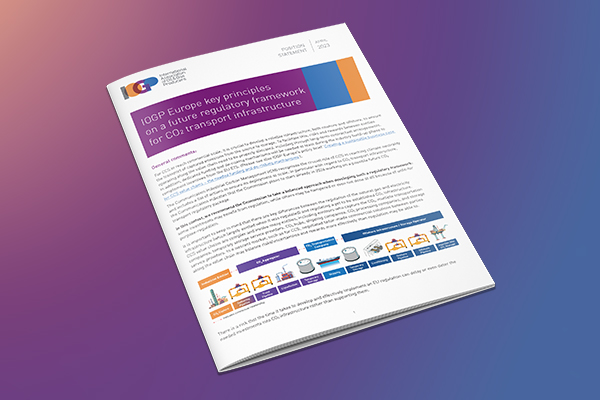
IOGP Europe key principles on a future regulatory framework for CO2 transport infrastructure
Joint Letter- Harnessing the IPCEI mechanism for CCS in Europe
GasNaturally Letter to Competitiveness Council 23 May 2024

IOGP Europe key principles on a future regulatory framework for CO2 transport infrastructure
Creating a sustainable business case for CCS value chains
IOGP Europe statement on the ECHA proposed PFAS restriction proposal related to the Carbon Capture, Transport and Storage (CCS) Technology
IOGP Europe position on the EU Industrial Carbon Management
IOGP position paper on the European Commission’s public consultation on the EU climate target for 2040
IOGP Europe feedback on Net Zero Industry Act proposal
IOGP response on revamping the Strategic Energy Technology (SET) Plan
Re-Stream – Study on the reuse of oil and gas infrastructure for hydrogen and CCS in Europe
IOGP response to public consultation on the revised Climate, Energy and Environmental Aid Guidelines (CEEAG)
IOGP Paper on metric to use for 2030 targets
IOGP response to the roadmap on the modification of the General Block Exemption Regulation (GBER)
IOGP written input to the consultation “Maritime sector – a green post-COVID future”
Funding CCS in Europe: key investments for the recovery
IOGP response to the public consultation on the revision of Regulation (EU) 347/2013 on guidelines for TEN-E Regulation
IOGP response to targeted consultation on the revision of Regulation (EU) 347/2013 on guidelines for TEN-E Regulation
IOGP input to the Roadmap on the EU Smart System Integration
IOGP feedback to the Combined Evaluation Roadmap/Inception Impact Assessment on the revision of Regulation (EU) 347/2013 on guidelines for TEN-E
IOGP input to the forthcoming EU Strategy for Energy System Integration
New and old CCS projects in Europe: What’s different this time?
IOGP assessment of National Energy and Climate Plans
IOGP assessment of draft National Energy and Climate Plans
The potential for CCS and CCU in Europe Report to the thirty second meeting of the European Gas Regulatory Forum 5-6 June 2019
CCS: the Innovation Fund and beyond
OGP contribution to the CCS Directive evaluation

Declining number of announced CO₂ storage projects in Europe highlights gap between EU’s 2030 target and operational reality.

New Pact for the Mediterranean: an opportunity to foster the region’s energy integration

Press release: 2040 Climate trajectory requires urgent action on policy enablers
Press release: State Aid Framework for Clean Industrial Deal marks a turn towards pragmatic decarbonization
Press release: Low-carbon fuels methodology envisaged by the Commission will block key hydrogen production pathways
Joint Letter: Accelerating investments in CO₂ infrastructure
Press Release: Roadmap to end Russian energy imports will require policy signals and regulatory adjustments to succeed.

MEP Jeannette Baljeu on the Crucial Role of CCS in Europe’s Industrial Transition
Draghi Report: a pragmatic pathway to Competitiveness, Sustainability, and Resilience
Press release: Recognition of CCS on path to 2050 marks a step change, but approach to low-carbon solutions remains too narrow.
Letter: Strong support for an implementable and pragmatic Net Zero Industry Act Article 18 – solutions to make CCS work
Net-Zero Industry Act marks a step change in industrial and climate policy – EU paves way for carbon capture and storage scale-up
Letter: Open, inclusive, and pragmatic Green Deal Industrial Plan for Europe
Europe needs a CO2 storage ambition for 2050
Gas market reform marks a step change in EU approach to the transition
New Re-Stream study assesses the feasibility of transport of hydrogen and CO2 in European gas and oil infrastructure
Letter: Call for a technology-inclusive revision of the TEN-E Regulation
Letter: 57 industry leaders call for enhancing gas contribution to decarbonisation

Carbon Management Webinars
Joint letter: CCS and CCU for the EU’s Industrial Transition

Carbon Capture Europe Summit 2026 | Rotterdam | 11-12 March 2026