IOGP Europe’s input to the Commission’s draft guidance on the application of the ‘do no significant harm’ principle under the 2028-2034 Multiannual Financial Framework (MFF)
In this consultation response, IOGP Europe supports a simpler, more predictable and proportionate application of the Do No Significant Harm (DNSH) principle under the 2028–2034 Multiannual Financial Framework.
IOGP Europe believes that certain sections of the draft guidance on the application of the ‘do no significant harm’ principle under the 2028-2034 MFF require refinement in order to provide greater clarity, reduce administrative burden and avoid blanket exclusion of technologies that would go against the principles of technology neutrality, industrial resilience and energy security for the EU.
1. Avoid blanket exclusions: recognise credible transition pathways
Applying a blanket exclusion to all fossil fuels disregards the reality that hard-to-abate industries will decarbonize progressively as technologies, infrastructures and competitive low-carbon energy becomes available.
A rigid exclusion of investments associated with existing oil and gas activities could prevent financing for projects that materially reduce their environmental footprint (e.g. transitioning to lower-carbon intensity energy systems or the repurposing of energy infrastructure).
2. Apply proportionality to actual environmental impact
DNSH assessments should reflect the actual environmental risk, scale, purpose and characteristics of an investment, rather than rely primarily on project value or broad technology classifications.
Compliance within existing EU frameworks, best available techniques (BAT), the EU ETS, the Industrial Emissions Directive and environmental permitting requirements should create a “presumption of compliance” with DNSH criteria, therefore avoiding duplicative documentation and parallel verification systems.
3. Ensure industrial decarbonization thresholds are achievable
The proposed 30-40% minimum GHG reduction threshold for certain industrial investments is too rigid and risks penalizing those whose remaining abatement potential is smaller, technically more complex or more expensive, such as:
- Investments in first-of-a-kind or innovative technologies;
- Necessary investments forming part of a wider, phased approach towards industrial decarbonization;
- Industrial frontrunners that have already delivered substantial emission reductions.
IOGP Europe recommends a 10-20% threshold alongside recognition of investments forming part of credible and time-bound decarbonisation pathways.
4. Energy security and resilience must be part of DNSH implementation
Environmental objectives should be implemented consistently with the EU’s wider priorities, including energy security, food security, industrial competitiveness and strategic autonomy.
The concepts of “crisis” and “overriding public interest” should therefore explicitly recognise energy-supply disruptions, critical energy infrastructure, diversification of supply routes and the need to maintain strategic industrial capacities.
IOGP Europe therefore calls for a DNSH framework that is technology-neutral in its application and proportionate to environmental harm, for it to be capable of supporting credible transition pathways and of incentivizing measurable decarbonisation and transformation of energy systems.
- Publications
- News
- Events

Upstream Oil & Gas and CCS operations in Europe: Perspective on a proposed EU Universal-PFAS Restriction
IOGP Europe feedback on the Call for Evidence: Simplification of administrative burden in environmental legislation
IOGP Europe response to DG ENVI and Trinomics survey on assessment of environmental reporting and the potential for simplification
IOGP Europe response to the ECHA consultation on Universal PFAS restriction proposal
Download
IOGP Europe statement on the ECHA proposed PFAS restriction proposal related to the Carbon Capture, Transport and Storage (CCS) Technology
IOGP response to consultation on the evaluation of the ‘Polluters pays principle’.
IOGP input on EU Soil Health Law for protecting, sustainably managing and restoring EU soils
IOGP position on Industrial Emissions Directive (IED) revision proposal
IOGP position on Industrial Emissions Portal (IEP) Regulation proposal
IOGP input to the call for evidence on ‘soil health – protecting, sustainably managing and restoring EU soils’
IOGP input to the call for evidence on ‘setting the course for a sustainable blue planet, an update of the international ocean governance agenda’
Input to Consultation: Restriction for per- and polyfluoroalkyl substances (PFAS)
IOGP consultation response, review of the Marine Strategy Framework Directive (MSFD)
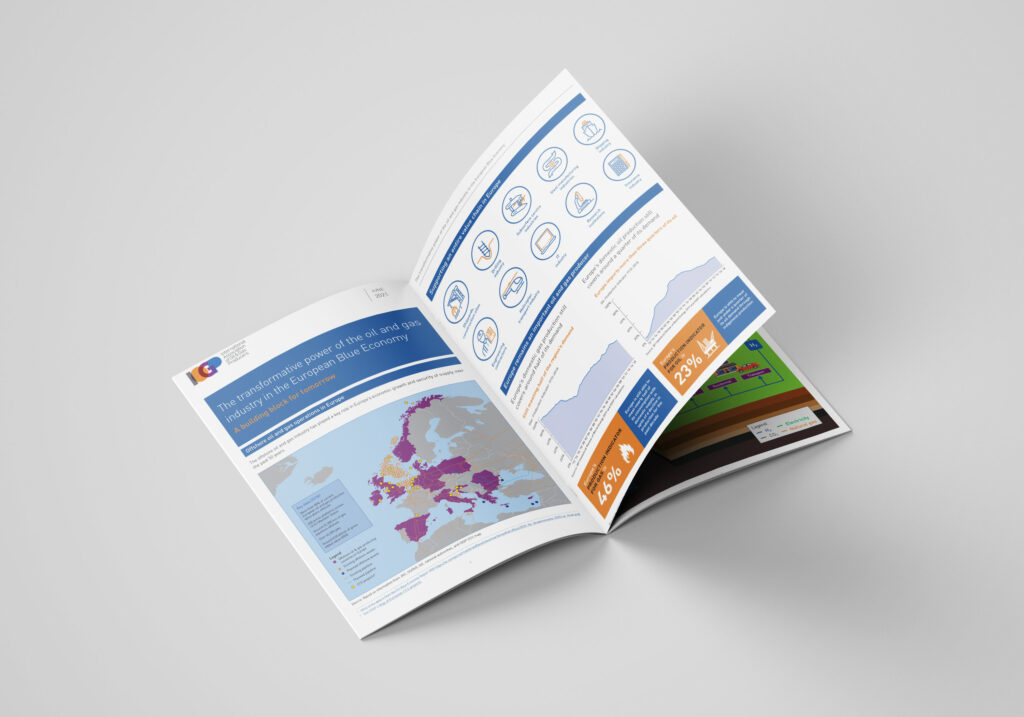
The transformative power of the Oil & Gas industry in the European Blue Economy
IOGP input to Roadmap consultation ‘Protecting the marine environment – review of EU rules’
IOGP input to the consultation on the new EU Soil Strategy
Underwater sound – Perspective from the oil and gas offshore industry in Europe
Public consultation on the EU Action Plan “Towards a Zero Pollution Ambition for air, water and soil”
IOGP response to the Inception Impact Assessment on the revision of the Guidelines on State aid for environmental protection and energy (EEAG) 2014-2020
IOGP written input to the consultation “Maritime sector – a green post-COVID future”
IOGP position on EU Biodiversity Strategy for 2030
IOGP written input to the consultation “International Ocean Governance”
IOGP input to the consultation on the EU nature restoration plan
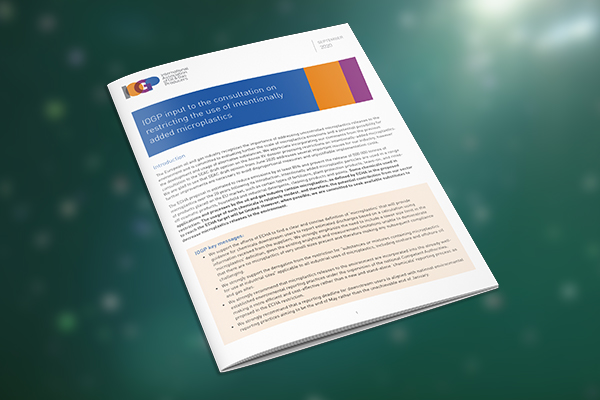
IOGP input to the consultation on restricting the use of intentionally added microplastics
Webinar: Regulating the re-use and repurposing of oil and gas installations in the context of decommissioning

IOGP actions to protect Biodiversity