Joint Letter – IPCEI to accelerate the deployment of Europes ICM value chain
Calling for the launch of an Important Project of Common European Interest (IPCEI) to accelerate the deployment of Europe’s integrated Industrial Carbon Management value chain
Dear Member State representatives to the JEF-IPCEI,
The undersigned call on Member States to initiate a JEF-IPCEI identification process for an integrated industrial carbon management value chain for carbon capture, utilisation and storage (IPCEI on ICM). The Commission’s 2024 Industrial Carbon Management Strategy envisaged working with Member States through JEF-IPCEI on an IPCEI for CO₂ transport and storage infrastructure. We propose translating that commitment into a co-investment programme linking industrial capture, cross-border transport, utilisation and permanent storage.
An IPCEI on ICM would ensure a coordinated value-chain investment approach. Carbon capture and storage (CCS) is a critical enabler for the decarbonisation of hard-to-abate industrial processes while retaining production and employment in Europe. The Commission’s ICM strategy estimates approximately €3 billion in storage investment and €6.2–9.2 billion in associated transport infrastructure, needed to support the Net Zero Industry Act objective of 50 million tonnes of annual EU CO₂ injection capacity by 2030 – though overall investment needs across the CCS value chain are likely to be substantially higher.
To create positive investment conditions and a solid business case, injection capacity must develop alongside capture volumes and transport connections, ensuring that investments across the CCS value chain translate into effective emission reductions for industrial consumers.
Investments are held back by a systemic coordination failure across the value chain. A July 2026 JRC assessment estimates industrial capture costs of €40–235 per tonne, before transport and storage services needed for CCS. The ETS provides an essential incentive, but its price signal alone cannot resolve cross-chain dependencies or ensure that early projects recover their full costs. Capture investors need related transport and storage; infrastructure investors need committed volumes. While non-pipeline transport can offer early flexibility for smaller CO₂ volumes, low initial capacity uptake raises unit costs and weakens the business case for networks, terminals and storage sites. Coordinated support and risk sharing can break this cycle by aligning investment decisions across the value chain, facilitating long-term commitments, pooling demand and providing a credible pathway to higher capacity uptake.
Therefore, there is a need for an IPCEI on ICM, connecting industrial emitters and clusters across participating countries to existing and planned storage in the most efficient and effective way, through interoperable pipelines, road and rail transport, shipping routes, intermediate terminals and storage facilities, with eligible capture innovations and first industrial deployment.
Shared infrastructure would enable access for additional emitters, including SMEs and industries in countries without suitable domestic storage; common standards and knowledge sharing would extend benefits beyond the initial participants. The added value of an IPCEI would lie in coordinating interdependent investments and addressing cross-border funding and coordination gaps that existing national and EU instruments cannot adequately resolve on their own.
Building on the experience and lessons from the hydrogen IPCEIs, especially the Hy2Use and Hy2Infra waves, the identification and implementation process should be streamlined to ensure early coordination across the entire value chain, predictable approval and funding timelines, and sufficient flexibility to manage delays in interdependent projects.
Timing is critical. Starting identification and progressing design in 2027 would provide qualifying projects with enough time to seek IPCEI top-ups envisaged under Article 19 of the proposed European Competitiveness Fund (ECF) from 2028 and co-financing under the Industrial Decarbonisation Bank (IDB), further strengthening their business case.
The design must demonstrate the necessity and proportionality of the IPCEI through project-specific counterfactuals, funding gaps, significant private co-financing and measurable cross-border spillovers. Support should be limited to eligible, additional investment, with non-discriminatory infrastructure access, Do No Significant Harm evidence and safeguards against overcompensation. An IPCEI on ICM should complement existing national support schemes, the Innovation Fund and the Connecting Europe Facility, as well as the upcoming IDB and ECF, while avoiding duplication and unnecessary administrative complexity.
We therefore invite Member States to initiate an identification process for an IPCEI on ICM, designate coordinating authorities and request a scoping exercise.
The undersigned stand ready to collaborate with the JEF-IPCEI in providing evidence on project maturity, investment needs, CO₂ volumes, cross-border dependencies and delivery schedules to support the development of an IPCEI on ICM.
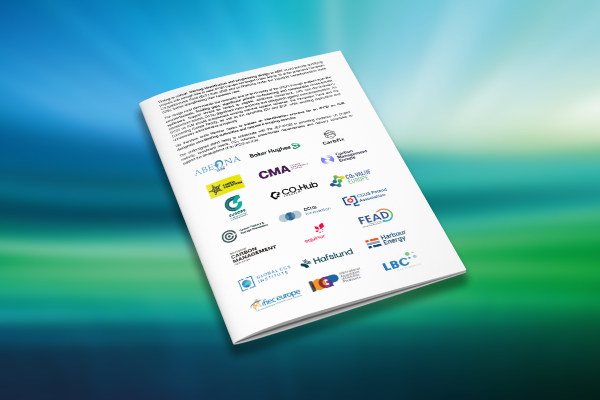
Signatories
























- Publications
Joint Industry Paper on DNSH guidance for the MFF 2028-2034
IOGP Europe’s Consultation Response to the 2nd wave of Revision of REMIT Reporting

IOGP Europe’s Consultation Response to the Revision of REMIT Reporting

IOGP Europe position on Industrial Accelerator Act and recommendations for modifications

Reforming energy taxation, charges and levies to support affordability

IOGP Europe’s response to the Stakeholder Consultation on MoP (Annex VII – Inside Information)
IOGP Europe’s response to the Targeted consultation on assessing the usefulness of ISO 20022 standard for REMIT Exposure data reporting

IOGP Europe’s response to the call for evidence on Foreign Subsidies Regulation (FSR)
IOGP Europe’s response to draft revision of the REMIT Implementing Regulation on data reporting public consultation

IOGP Europe’s response to Inside information platforms and registered reporting mechanisms under REMIT – Commission Regulation public consultation

IOGP Europe’s response to ESMA consults on clearing thresholds under EMIR 3

Public consultation on inter-temporal cost allocation mechanisms (ICA) for financing hydrogen infrastructure

Joint industry position on EMIR 3 trialogues
IOGP response to the public consultation on the Energy Taxation Directive (ETD) proposal
IOGP written input to the public consultation on the revision of the Energy Taxation Directive (ETD)