
16.09.2025
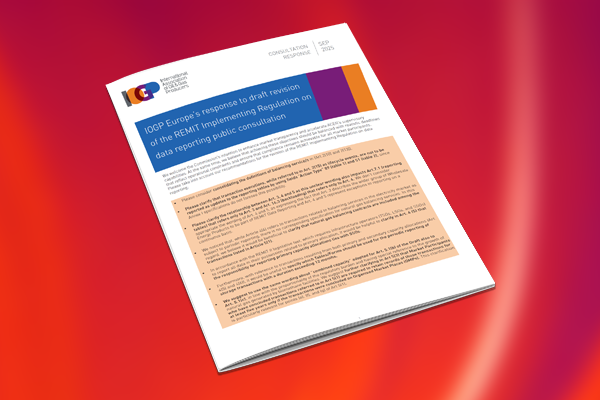
IOGP Europe’s response to draft revision of the REMIT Implementing Regulation on data reporting public consultation
We welcome the Commission’s intention to enhance market transparency and accelerate ACER’s supervisory capabilities. At the same time, we believe that achieving these objectives should be balanced with realistic deadlines that reflect operational constraints and ensure that compliance remains achievable for all market participants. Please take into account our recommendations for the revision of the REMIT Implementing Regulation on data reporting:
- Please consider consolidating the definitions of balancing service/s in (Art.2(10) and 2(13)).
- Please clarify that transaction executions, while referred to in Art. 2(15) as lifecycle events, are not to be reported as updates to the reporting tables by using fields “Action Type” 89 (table 1) and 51 (table 2), since Annex I specifications do not foresee this possibility.
- Please clarify the relationship between Art. 3, 4 and 5 as this unclear wording also impacts Art.7.1 (reporting tables) that refers only to Art. 3 and Art. 16.3 (backloading) that refers only to Art. 4. We don’t consider appropriate the wording of Art. 4 and 5, as expressing the fact that Art. 3 describes the wider group of Wholesale Energy Products to be part of REMIT Data Reporting and Art. 4 and 5 represent exceptions to reporting on a continuous basis.
- We noticed that, while Article 4(4) refers to transactions related to balancing services in the electricity market as subject to periodic reporting, there is no corresponding specification for natural gas balancing services. In this regard, we believe it would be beneficial to clarify that natural gas balancing contracts are included among the transactions listed in Article 5(1).
- In accordance with the REMIT II legislative text, which requires infrastructure operators (TSOs, LSOs, and SSOs)to report all data in their possession related to primary allocation, it would be helpful to clarify in Art. 4 (5) that the responsibility for reporting primary capacity allocations lies with SSOs.
- Furthermore, with reference to transactions resulting from both primary and secondary capacity allocations (Art.4(5) and 4(6)), it would be useful to specify which Tables/Forms should be used for the periodic reporting of storage transactions with a duration exceeding 12 months.
- We suggest to use the same wording about “combined capacity” adopted for Art. 5.1(b) of the Draft also to Art. 5.1(c), in line with the proportionality of the regulatory burden and having special reference to the growth of natural gas generated by biomethane facilities. We suggest further clarifying in Art 5(3) that Market Participants who have concluded transactions referred to in Art 5(1) are required to retain records of those transactions for at least five years only if the transactions were concluded.
- We urge to officially establish within the text a reasonable deadline by which ACER must publish the complete set of documentation required, as already foreseen in Article 9 of the draft Delegated Act on Inside Information Platforms and Registered Reporting Mechanisms under REMIT. Since REMIT data reporting (by RRMs and, cascading, OMPs and Market Participants) critically depends on ACER’s guidance and detailed technical specifications - not only documentations but also XML and XSD standards. The deadline (even if phased) should be aligned with the timelines necessary for stakeholders to implement the required changes within their respective responsibilities.
- With regards to Exposure Reporting, we would also like to express our strong concern for the proposed implementation timeline of April 2027 (ex Art. 6.1) and the start of application 6 months after the entry into force of the Commission Implementing Regulation (ex. Art. 17.2). This proposed timetable is inadequate given the complexity and novelty of the reporting requirements. We would like to highlight that that provisions on Exposure Reporting are not about the update or the reshuffling of a reporting flow that already exists and that is already part of REMIT data reporting, but require building from scratch a brand new flow, involving in the most of the cases entities (e.g. entities that only perform intragroup transactions) and data streams (e.g. forecasted values of production and consumption) that at the moment are not at all included in the REMIT processes and are build and clustered with materially different logics and keys. Therefore, we firmly believe that a longer lead time of at least 12 months after the complete publication by ACER of all technical specifications is essential for effective implementation. We base our belief on over ten years of industry experience in implementing and working with REMIT data reporting on a daily basis.
- On Exposure Reporting, we appreciate that stakeholders’ feedback has been considered in relation to the initially proposed forward-looking reporting horizon of 36 months. However, we recommend that the reduction be set at 18 months rather than 24 months, in order to align with industry practices. In most cases, the physical commercial backbone of the industry is structured through a sequence of energy purchase and sale contracts, typically concluded up to 6 months in advance and covering a contractual period of 12 months. This results in an overall commercial visibility of approximately 18 months, making a 24-month horizon inconsistent with market realities.
- We support the taken decision to adopt a threshold to limit the number of Market Participants subject to the Exposure Reporting provision. Still, we deem that the proposed threshold is not suited for the purpose. The threshold included in the Draft, following the already existing threshold of 600 GWh/y technical consumption included in REMIT level one text, could have only the effect of limiting the application of Exposure Reporting to those entities that are not Market Participants and, therefore, already excluded by definition from the application of REMIT provisions. To really achieve the target to exempt smaller Market Participants from Exposure Reporting requirements, we propose to raise the “absolute” value of the proposed threshold to 5 TWh/y, which better reflects the scale at which a Market Participant could have a material influence on Wholesale Energy Markets dynamics, prices, or liquidity. Alternatively, the threshold of 600 GWh/y included into the Draft could be applied for “net” values - instead of “absolute” ones – i.e., netting between production and trading and between trading and consumption. This would give a more accurate picture of exposure for companies. For example, this method might be helpful for companies running smaller power plants, like those producing 10 MW, that also have deals to sell the energy produced, or for big energy consumers that, by definition, use a lot of energy and have contracts in place for such a supply.
- With regard to the proposed shortening of the reporting deadline for OTC (bilateral) contracts from the current 30 days to 10 calendar days, we would like to stress that such a deadline can only be considered feasible provided that Article 4(2) remains in its currently proposed form, i.e. transactions relating to the supply or storage of electricity and the supply of natural gas to consumption units with a technical capacity of ≥600 GWh/year should be reported every six months. However, should Article 4(2) be amended or deleted in the course of the legislative process, it would then be necessary to extend the reporting deadline for OTC contracts from 10 to at least 20 calendar days. The justification is the scale and complexity of data verification and preparation processes, which, if additional transactions were to fall under continuous reporting obligations, would significantly increase the operational burden on market participants.
- In addition, it should be underlined that in the case of OTC contracts concluded with new counterparties, it is often necessary to first negotiate and sign a reporting agreement on behalf of the counterparty, as well as to complete the required formalities with an RRM. Importantly, this timeline is not always within the control of the market participant, as it depends on the internal procedures and processing times of the chosen RRM. These steps may therefore take longer than 10 calendar days, creating a risk of unintentional non-compliance with reporting obligations by market participants. Furthermore, excessively short deadlines may in practice discourage or delay supplier switching, as suppliers and customers could be reluctant to engage with new counterparties if reporting obligations cannot be reliably met in time. This would have a negative effect on market dynamics and would be detrimental to the development of competition.
- We believe that Exposure Reporting should remain the responsibility of individual legal entities, without imposing group-level reporting obligations inconsistent with REMIT Level 1 Regulation.
We consider premature to set a deadline of 1 November 2030 to assess whether the applicable data reporting rules set out in this Regulation, particularly the data reporting rules on hydrogen, continue to be fit for purpose or require amendments. Considering that the implementation phase for data reporting will not be completed before 1 July 2028, a two-year evaluation period is insufficient to assess the effectiveness of the adopted solution. Furthermore, Market Participants are going to be required to make significant investments to comply with these new data reporting rules, and it would be inconsistent with the principles of European regulation to foresee a revision after such a short period. - We also recommend limiting the “backloading requirement” under Article 16.3 to new contract types, and not applying it to all transactions included in Art. 4. In particular, for those transactions already part of ordinary reporting. For example Commission Implementing Regulation 1348/2014, it seems unnecessary to go further with a new reporting of records that have already been reported to ACER.
- We caution against the proposed granularity in reporting of the field “Algorithm ID” (Annex I, Table 1, Field 5) for each strategy or parameter change. Such requirements are operationally complex and may not yield meaningful insights. In particular, it should be clear that:
- strategies may evolve naturally in response to market conditions, not solely due to changes in the “algorithm’s code”;
- a single algorithm may execute multiple strategies simultaneously, making strict one-to-one mapping impractical;
- in cases of dynamic parameterization, strategies/parameters may shift frequently - also every 15 minutes making real-time ID changing extremely confusing from a monitoring perspective / unfeasible as it requires a complexity that goes beyond what is required for manual data reporting.
- Publications
23.09.2026
Consultation Response
IOGP Europe’s Consultation Response to the 2nd wave of Revision of REMIT Reporting
Download the listed documents to view IOGP Europe's responses to the 2nd wave of REMIT Public Consultations....
Read more

17.06.2026
Consultation Response
IOGP Europe’s Consultation Response to the Revision of REMIT Reporting
Download the documents to see IOGP Europe's consultation response to the Revision of REMIT Reporting...
Read more

16.06.2026
Position Paper
IOGP Europe position on Industrial Accelerator Act and recommendations for modifications
Executive Summary
IOGP Europe recognises the Industrial Accelerator Act (IAA) as a positive step toward the creation of lead markets to stimulate demand for low-carbon products. To fully realise this...
Read more

06.03.2026
Joint Statement
Reforming energy taxation, charges and levies to support affordability
Europe needs lower and more predictable energy bills for all energy carriers, faster electrification based on decarbonised energies where it is feasible and cost-efficient from an energy system perspe...
Read more

20.02.2026
Consultation Response
IOGP Europe’s response to the Stakeholder Consultation on MoP (Annex VII – Inside Information)
This response presents IOGP Europe’s views on ACER’s stakeholder consultation regarding the update of the Manual of Procedures (MoP), specifically Annex VII (Inside Information data fields), Annex...
Read more
06.02.2026
Consultation Response
IOGP Europe’s response to the Targeted consultation on assessing the usefulness of ISO 20022 standard for REMIT Exposure data reporting
This response sets out IOGP Europe’s views on ACER’s targeted consultation assessing the potential use of the ISO 20022 standard for reporting Exposure data under the revised REMIT framework. The...
Read more

19.11.2025
Consultation Response
IOGP Europe’s response to the call for evidence on Foreign Subsidies Regulation (FSR)
Reflecting on the experience already gathered from implementing the FSR, we would like to draw attention to some important elements that the Commission should reconsider, reviewing some of the design...
Read more

16.09.2025
Consultation Response
IOGP Europe’s response to Inside information platforms and registered reporting mechanisms under REMIT – Commission Regulation public consultation
We welcome the provision under Article 9 of this regulation, which officially establishes a deadline for Agency for the Cooperation of Energy Regulators (ACER) to elaborate guidance documentation.
In...
Read more

23.06.2025
Consultation Response
IOGP Europe’s response to ESMA consults on clearing thresholds under EMIR 3
IOGP Europe welcomes the opportunity to contribute to ESMA’s consultation on draft technical standards for the EMIR 3 clearing threshold regime. Our response focuses on the commodity asset class, hi...
Read more

01.04.2025
Consultation Response
Public consultation on inter-temporal cost allocation mechanisms (ICA) for financing hydrogen infrastructure
IOGP Europe has responded to ACER's public consultation on intertemporal cost allocation (ICA) mechanisms for financing hydrogen infrastructure, underlining their importance in enabling early-stage hy...
Read more

17.01.2024
Joint Statement
Joint industry position on EMIR 3 trialogues
IOGP Europe and its partners in the Joint Energy Associations Group (Eurogas, BDEW, EFET, Eurelectric, and IOGP) support the changes to EMIR 3 agreed upon by all three EU institutions regarding the ca...
Read more
19.10.2021
Consultation Response
IOGP response to the public consultation on the Energy Taxation Directive (ETD) proposal
This document provides IOGP’s response to the EU public consultation on the Energy Taxation Directive (ETD) proposal.
Context
The ETD should be an instrument...
Read more
20.10.2020
Consultation Response
IOGP written input to the public consultation on the revision of the Energy Taxation Directive (ETD)
This document provides IOGP’s written input to the Commission’s consultation on the revision of the
Energy Taxation Directive (ETD).
The ETD should be an instrument that incentivises the...
Read more
19.10.2020
Consultation Response
IOGP contribution to the public consultation on Commission Decision setting the fees due to ACER for tasks under REMIT
This document provides IOGP’s contribution to the public consultation on the proposed Commission Decision to introduce fees to ACER for REMIT activities.
Overview
The document prov...
Read more