
EU Methane Regulation: Two years to get compliance right, starting now
Brussels, 26 November 2026 – Today the European Parliament voted to endorse the provisional agreement reached with the Council to postpone key provisions of the EU Methane Regulation (EUMR) by two years. This helps reduce uncertainty for importers, suppliers and EU producers and gives policymakers the needed time to put a workable compliance framework in place – essential to deliver the environmental objectives of the Regulation, while safeguarding Europe’s energy security and affordability.
Time is now of the essence. As IOGP Europe’s EUMR compliance framework development tracker shows, the framework was not going to be ready in time for the original 1 January 2027 effective date for the Regulation’s importer rules: verification protocols must still be endorsed, verifiers accredited, producers verified and certification solutions deployed at scale. The challenge now, is to ensure all of this is completed and implemented in time for 2029.
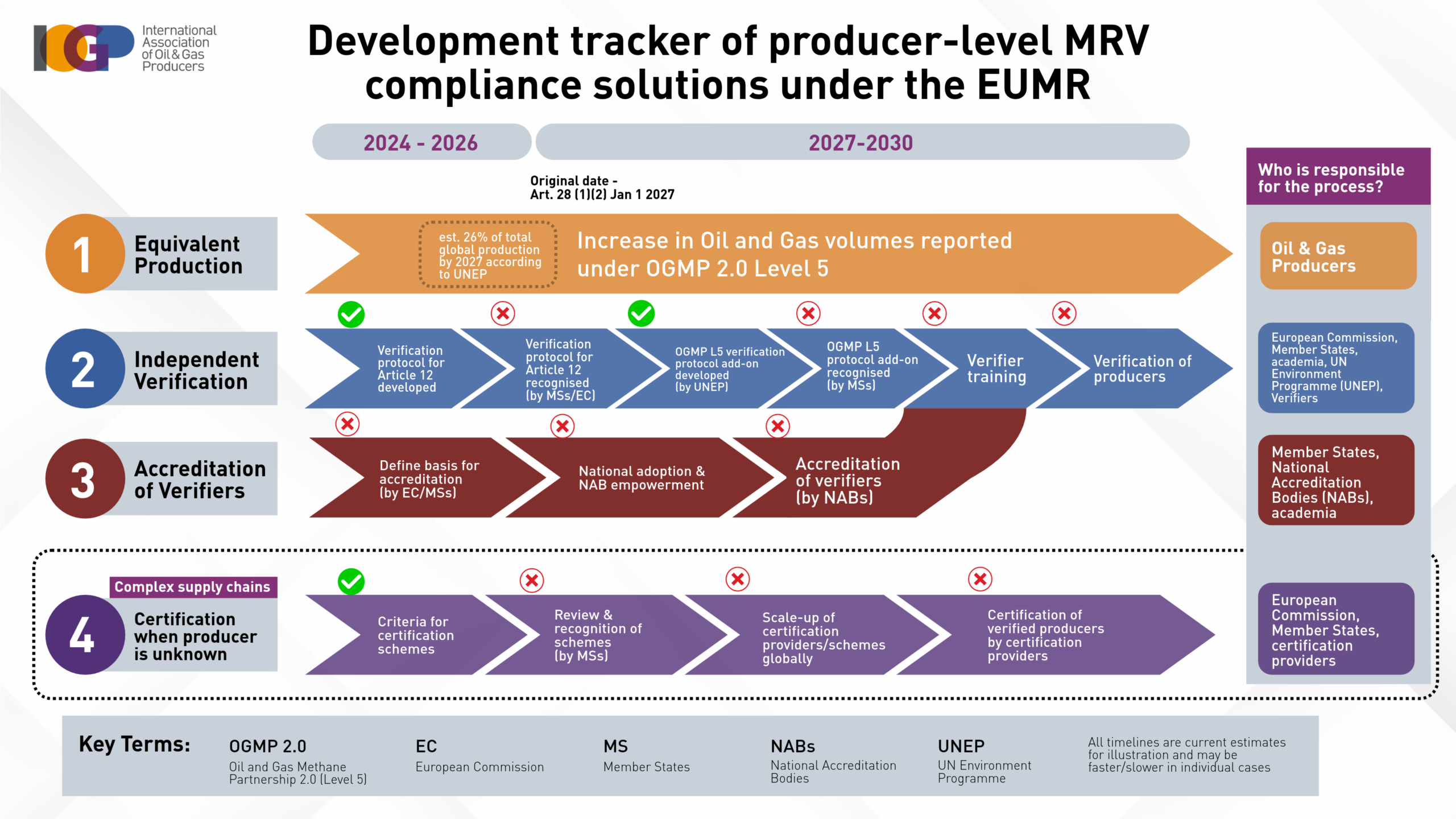
IOGP Europe calls on the Commission and Member States to publish a joint roadmap without delay, setting out clear milestones and responsibilities for all parties, and with regular progress reporting. The Commission’s review, due by 1 January 2028, should assess whether the framework is on track to be operational by the time the requirements apply.
François-Régis Mouton de Lostalot, Managing Director of IOGP Europe, said: “European policymakers should be commended for recognising the implementation challenge and for deciding to fix it. But two years will pass quickly. To meet Europe’s energy demand effectively, our industry needs the compliance framework to be up and running by 2029. We will continue our efforts to progress measurement, reporting and reduction of methane emissions, and we are committed to helping the Commission, Member States and other actors develop and implement a compliance framework that works in practice.”
“Despite this positive outcome, EU producers are still faced with unworkable leak detection and repair provisions under Article 14, which puts them at a disadvantage. We call on European policymakers to address this as soon as possible,” he added.
Oil & gas companies have for decades worked to reduce methane emissions, through individual and joint initiatives such as the Oil & Gas Climate Initiative, the Methane Guiding Principles and more recently the Oil & Gas Decarbonization Charter.
In parallel, production reported at Level 5 of the UN-backed Oil and Gas Methane Partnership 2.0 continues to grow. This experience will be key in making the EU framework work in practice.
The Council is expected to formally adopt the amendment in coming weeks. Publication in the EU Official Journal will follow, with entry into force expected before 1 January 2027.
Contact
Nareg Terzian, Head of Strategy and Communications
Email: gro.pgoi@ztn
www.iogpeurope.org
