
Council insists on completing Methane Regulation compliance framework, but one year delay falls short
Brussels, 6 November 2026 – By calling for a binding review mechanism, the Council today recognised that the EU Methane Regulation’s compliance framework must be complete and fully operational before the relevant requirements apply. However, one-year is insufficient to do so and merely extends the uncertainty period.
IOGP Europe calls for a final agreement that provides for a three-year postponement, while resolving outstanding challenges for EU producers to ensure a level playing field.
François-Régis Mouton de Lostalot, Managing Director of IOGP Europe, said:
“The Council has recognised that taking the time to finish and implement the compliance framework is more important than a rigid and unrealistic deadline. But the timetable must now reflect this principle. The final agreement should combine Parliament’s more realistic timeframe with the Council’s stronger review clause – and address the remaining challenges for European producers. We need a Regulation that delivers methane reductions while safeguarding Europe’s energy security and affordability.”
Why three years are still needed
The development tracker below illustrates how few compliance arrangements have been completed in the more than two years since the Regulation entered into force – and how much work remains. Most of these are outside producers’ and suppliers’ control:
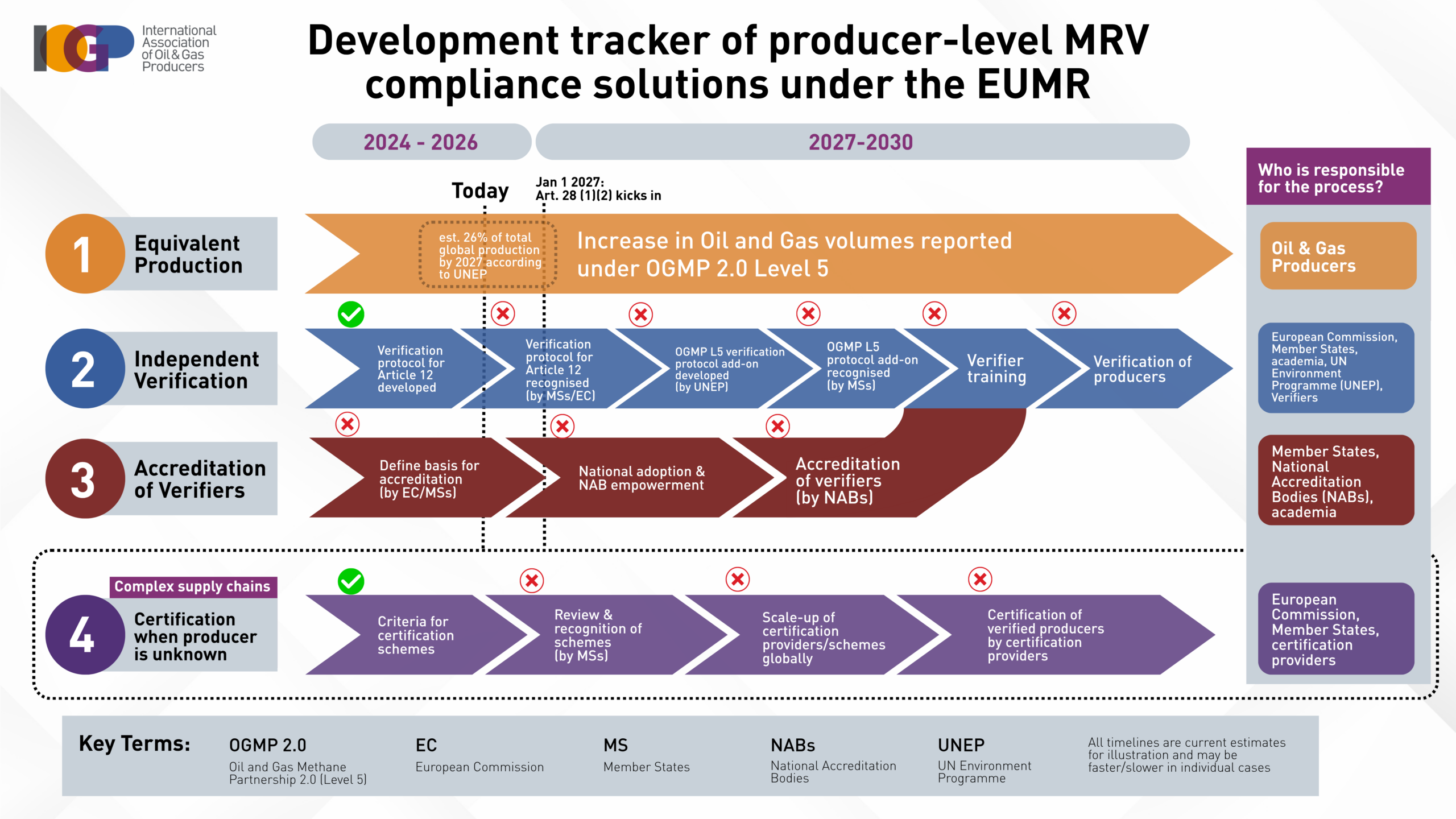
- The compliance framework remains incomplete. Operational MRV equivalence pathways, recognised verification protocols, accredited verifiers and certification solutions available at scale globally are still needed. Completing these requires coordinated action by the Commission, Member States, accreditation bodies, UNEP, service providers and producers worldwide. Importers cannot deliver this framework themselves.
- Compliance depends on sequential steps that take time. Agreed rules and legal basis must be in place before verifiers can be accredited; accredited and trained verifiers are needed to verify producers; and certification depends on verified production. These systems must then scale globally across complex international oil and gas value chains.
- Three years must be an active implementation period. Clear milestones and responsibilities should drive completion of the framework, expansion of verification capacity and increased availability of compliant supply. Meanwhile, producers will continue monitoring and reducing emissions and expanding the volumes reported at OGMP 2.0 Level 5.
Europe should learn from previous implementation challenges. Following a one-year postponement in 2024, the Deforestation Regulation required another legislative postponement twelve months later as implementation problems persisted. The Battery Regulation’s due diligence obligations were postponed by two years, partly because third-party verification arrangements were not ready.
European producers’ concerns must also be resolved
The Council’s proposed postponement and review arrangements for Article 12(3), covering domestic producers’ monitoring, reporting and verification obligations, are important to securing a level playing field with imports. However, outstanding implementation challenges under Article 14 on leak detection and repair remain unaddressed, particularly for offshore and subsea operations.
About IOGP Europe
IOGP Europe is the European advocacy arm of the International Association of Oil & Gas Producers (IOGP), the leading voice of the global oil and gas industry, pioneering excellence in safe, efficient and sustainable energy.
We represent around 30 energy companies accounting for 70% of EU oil & gas production, and many of Europe’s energy suppliers.
We support policymakers in crafting impactful and inclusive policies that drive prosperity for Europe's businesses and citizens.
Contact
Nareg Terzian
Head of Strategy and Communications
Email: gro.pgoi@ztn
www.iogpeurope.org
